12/1/25
Trent Carter and ChatGPT5.1
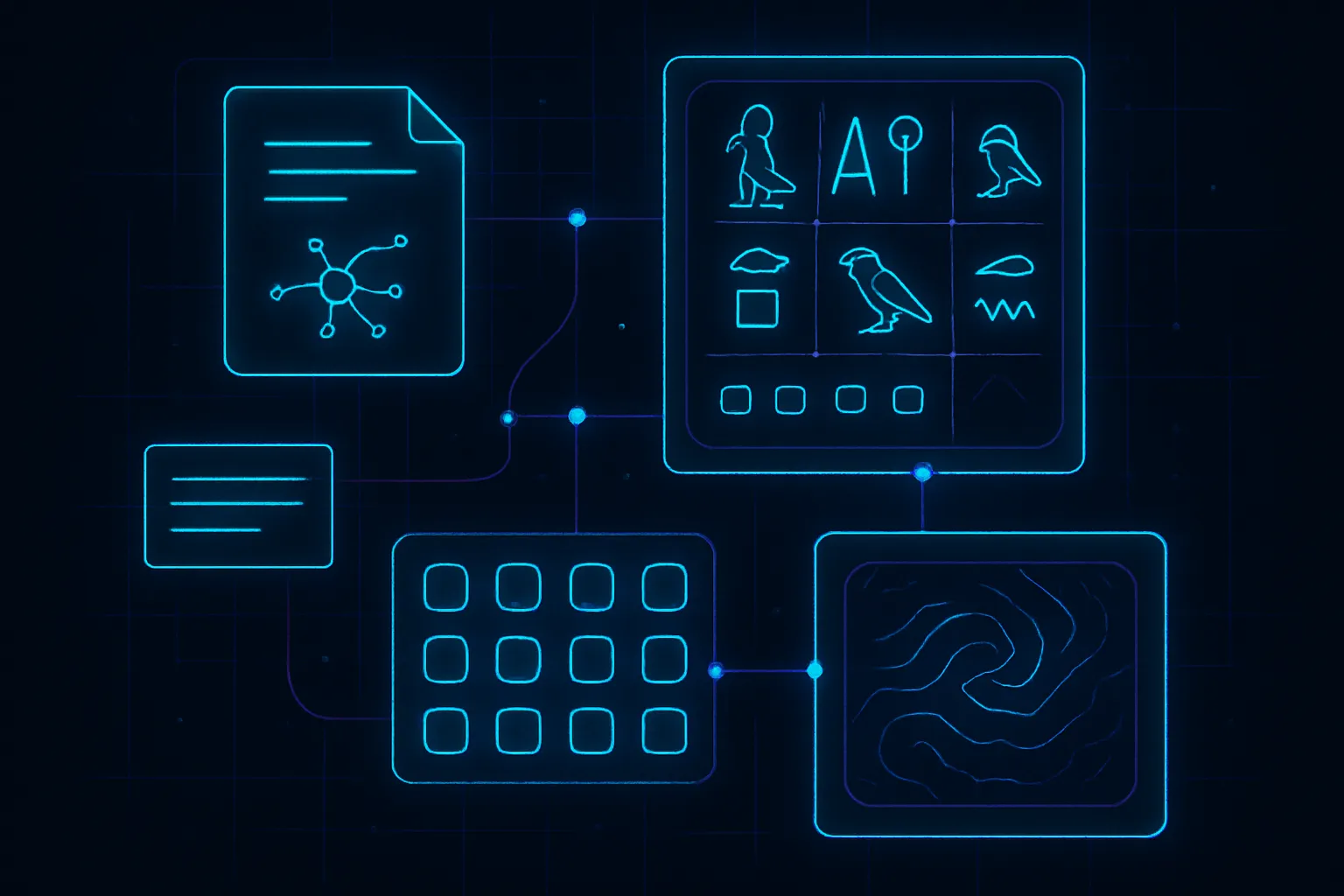
AbstractWe compare four representational systems for encoding a moderately detailed concept such as _“the impact of diabetes on insulin levels”_:
(1) Ancient Egyptian hieroglyphic writing,
(2) Modern English,
(3) a 50k-token subword LLM, and
(4) a 768-dimensional Latent Neurolese (LN) concept space.
The goal is to quantify how many primitive symbols, characters, and bits are needed to express a concept, and to show why a high-dimensional, concept-based latent language—especially when paired with a Mamba-style architecture—can be computationally more efficient despite using far more bits per unit. We argue that LN is essentially “hieroglyphs for machines”: a semantic glyph system in which geometry is meaning, and sequence length becomes the main driver of compute and memory.⸻
1. Four Systems for One Concept We fix a single target concept: Target concept: “the impact of diabetes on insulin levels”and ask: _how many primitive units do we need to encode this as a stable, reusable “concept handle”_?
1.1 Comparison tableAll numbers are rough, order-of-magnitude estimates.
System Basic symbolic unit Approx. inventory size (units) Avg. units to express the concept Approx. characters for that concept (written / stored) Mapping type Degree of polysemy / context dependence Semantic density per unit Approx. bits to uniquely pick this concept Similarity = geometry? Concept algebra / gradient-friendly? Ancient Egyptian hieroglyphic Glyph / sign (ideogram, phonogram, determinative) ~700–1000 signs; effectively ~10⁴–10⁵ conceptual “word+determinative” entries ~8–15 glyphs for a clause equivalent to “impact of diabetes on insulin levels” As glyphs: ~8–15 glyphs; as Latin transliteration: ~40–80 characters Mixed semantic + phonetic Medium – determinatives narrow the domain (disease, body, etc.), but sentence context still needed Medium–high – a single determinative can pack strong domain semantics ~17 bits (≈ log₂(10⁵) to identify a specific conceptual entry) Weak – some visual motivation, but no formal metric space No – you can’t do differentiable algebra on glyphs Modern English Orthographic word Active vocab ~2×10⁴–3×10⁴; full dictionary ~10⁵–10⁶ Natural clause: ~8–12 words for a self-contained statement of the concept ~5 letters/word + spaces ⇒ ~50–70 characters Mostly phonetic / morpho-phonemic High – “impact”, “levels”, etc. are heavily sense-loaded; disambiguation is contextual Medium – each word is a decent semantic chunk, but multi-sense ~18–19 bits (10⁵–10⁶ words/phrases) None in raw form – spelling similarity ≠ semantic similarity No – algebra lives in model embeddings, not in the orthography LLM with 50k subword vocab Subword token (BPE / WordPiece) 50,000 tokens; conceptual inventory still ~10⁵–10⁶ distinct n-gram patterns “the▁impact▁of▁diabetes▁on▁insulin▁levels” ≈ 7 tokens; more explicit clause: 10–14 tokens Underlying text ~30–50 characters Compression-driven subwords, not concept-aligned Very high – many tokens have weak standalone semantics; meaning is emergent over sequences Low–medium per token – tokens are mostly form/fragment carriers Concept space size similar to English (~10⁵–10⁶) ⇒ ~18–19 bits Only in latent space – raw token IDs have no geometry; embeddings introduce it Indirect – gradients act on embeddings/activations, not token IDs themselves 768-D Latent Neurolese Concept vector / “NeuroGlyph” (768-D) Effective concept dictionary ~10⁷–10⁸ stable vectors (continuous space allows more) Target: 1 composite NeuroGlyph encoding DIABETES → INSULIN_LEVELS effect, or at most 2–3 linked vectors (DIABETES, INSULIN_REGULATION, CAUSAL_IMPACT) One 768-D fp16 vector ≈ 768×2 bytes = 1536 bytes; serialized (JSON/base64/etc.) ≈ 2,000–4,000 characters (storage, not human symbols) Fully semantic by design – vector _is_ a concept Low–medium if monosemanticity is enforced: 1 vector ≈ 1 concept/proposition; context modulates, but doesn’t overload senses Very high – a single vector can encode entities, relation type, directionality, strength, domain If ~10⁷–10⁸ distinguishable concepts: ~23–27 bits (log₂(10⁷–10⁸)) for identity; the rest of the 12k bits shape the geometry Yes, by construction – distance and angle are _the_ semantics Yes, strongly – you do optimization directly over concepts (triplet loss, manifold regularization, etc.)⸻
2. Bits vs Meaning: Why LN “Wastes” Bits on Purpose At first glance, a 768-dimensional LN vector looks wasteful:• A single LN vector in fp16 has
768 dimensions × 16 bits ≈ 12,288 bits.
• To uniquely identify one concept out of 10⁸ possible concepts, you only need ~27 bits.
So purely as an _address_, a NeuroGlyph is massively over-provisioned.
But that’s exactly the point:
• Identity bits: which conceptual “slot” is this? (~25 bits for 10⁷–10⁸ slots)
• Geometric / structural bits:
• where it sits relative to other concepts,
• what local manifold it lies on,
• which directions correspond to which transformations (cause→effect, disease→symptom, hormone↑→blood_glucose↓, etc.).
LN is deliberately using a lot of extra representational capacity to encode:
• similarity structure,
• analogical axes,
• disentangled factors (disease type, organ, hormone, time-scale, severity),
_inside the concept code itself_, not in an external lookup table.
• A token ID is log₂(50,000) ≈ 15–16 bits.
• A single word in English concept space (10⁵–10⁶ words) needs ~17–20 bits of identity.
Both are near-minimal codes: they don’t carry more structure than necessary to identify “which symbol.” All geometry is added later by embedding layers.
LN, by contrast, bakes the geometry into the primary representation. The cost in raw bits per unit is the price you pay to make similarity, analogy, and structured variation directly available for computation.
⸻
3. Concept Language + Mamba: Why It’s Still More Efficient Even though each LN concept vector is “fatter” in bits than a token ID, a concept-based high-dimensional language can be computationally more efficient—especially in a Mamba-style state-space model—because:• You need far fewer time steps to express the same semantic content.
• Compute and memory scale linearly with sequence length in Mamba.
3.1 Sequence compression at the concept level Take the example concept again:• Token LLM:
• Text: “the impact of diabetes on insulin levels”
• Tokens: ≈ 7 subword tokens (or ~10–14 for a fuller clause)
• A richer scientific explanation might be 30–50 tokens.
• LN / Egyptian-LM style:
• You aim for 1 composite NeuroGlyph or 2–3 vectors for:
• DISEASE: diabetes,
• TARGET: insulin regulation,
• RELATION: impact/causal effect (possibly with magnitude or type).
For a whole paragraph explaining metabolic pathways, you might have:
• Tokens: ~200–300 tokens.
• LN concepts: maybe 20–30 NeuroGlyphs (each representing a fused chunk of meaning).
This is roughly a 10× compression in sequence length at the level where the model actually reasons.
3.2 Mamba’s linear scaling In a Mamba-style state-space model:• Per-step compute is roughly O(d²) (or O(d·k) depending on implementation), where d is the model dimension.
• Total compute ≈ O(L · d²) for sequence length L.
Memory for the sequence scales ≈ O(L · d).
The key is that:
• L = number of steps, not number of characters.
• If LN reduces effective steps from, say, 300 tokens → 30 NeuroGlyphs, you get:
• ~10× less compute for the same conceptual content.
• ~10× less activation memory for the context.
So even though each step handles a 768-D vector (more bits per unit than a token ID), the dominant factor is L, and L is much smaller in a concept language.
3.3 Linear context memory vs “semantic coverage” Your context window in a Mamba-LN model scales linearly with the number of concept steps:• Memory ∝ L · d
• With concept compression, L is small.
But the semantic coverage (number of distinct ideas you can carry in context) grows much faster than L because:
• Each LN step carries the semantic load of many tokens.
• And each vector has high semantic density.
In other words:
• Token LM:
• Context = many low-density units; semantics only emerges from long sequences and deep layers.
• LN + Mamba:
• Context = few high-density units; much of the semantics is already present at the input.
You are trading:
• Fewer, heavier steps (LN),
• For many, lighter steps (tokens).
Because Mamba scales linearly with L, the heavier steps don’t dominate; the reduction in L wins.
⸻
4. “The Egyptian Language Model” as a Mental Model The analogy to hieroglyphs is more than aesthetic:• Glyph system with semantic hints (ideograms, determinatives) layered over phonetics.
• A small number of glyphs can directly point at a concept domain.
• Vector system with pure semantics—no phonetic baggage.
• A small number of high-dimensional glyphs (NeuroGlyphs) can directly encode:
• diabetes,
• insulin regulation,
• the causal impact relationship between them.
As a mental label, “ELM” is:
• A language model that thinks in hieroglyphs for machines:
• concept glyphs = 768-D NeuroGlyphs,
• grammar = learned relations and trajectories in latent space,
• “script” = sequences of NeuroGlyphs fed into a state-space core (Mamba).
• Textual tokens (Ainglish, English, whatever) become _just another interface_:
• encoder: text → NeuroGlyphs,
• decoder: NeuroGlyphs → text,
while the core reasoning is glyph-native.
⸻
5. Implications for LNSP / LVM Design Putting this in your LNSP/LVM framing:• Design goal:
Make the LN concept layer primary, and the token layer secondary.
• Architectural choice:
Use a Mamba-like state-space model over sequences of NeuroGlyphs, not tokens.
• Efficiency payoff:
• Concept compression gives you shorter effective sequences.
• Mamba gives you linear compute/memory in sequence length.
• So you get higher semantic capacity per unit compute than token-based Mamba or transformers.
And the Egyptian analogy gives you a clean narrative:
If the Egyptians built a language model today,
they probably wouldn’t optimize character compression.
They’d design a small, powerful glyph system whose geometry _is_ meaning.
Latent Neurolese is exactly that—just in 768 dimensions.
⸻
If you want, next step is to turn this into a proper arXiv-style paper skeleton (Intro / Related Work / Method / Experiments / Discussion) and plug it into the broader LNSP architecture docs.