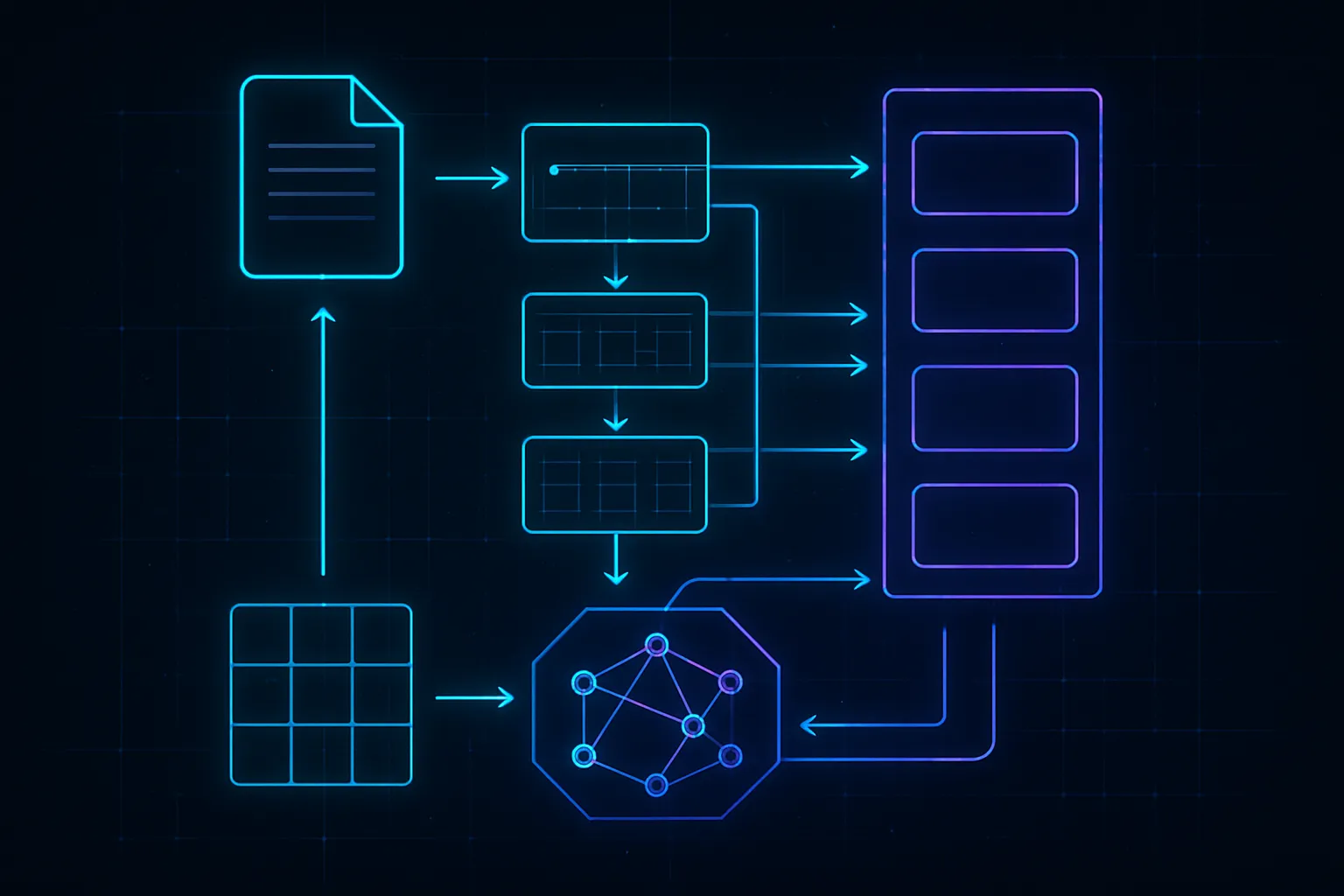
Product Requirements Document: Text-Vector-Text Pipeline with VMMoE Integration
Document Version: 1.0 Date: 2025-08-25 Status: Development ReadyExecutive Summary
The Text-Vector-Text (TVT) pipeline integrates GTR-T5 encoding, VMMoE next-concept prediction, and multiple vec2text decoder implementations to create a comprehensive concept transformation and validation system. The pipeline operates in two modes: (1) Direct validation path for baseline semantic preservation testing, and (2) Generative transformation path using VMMoE for next-concept prediction.
🎯 Key Innovation: The system combines semantic preservation validation with generative concept transformation, providing both quality baselines and creative concept evolution capabilities through the VMMoE model.System Architecture
Pipeline Components
┌────────────────────────────────────────────────────────────────────────────┐
│ Text-Vector-Text Pipeline │
├────────────────────────────────────────────────────────────────────────────┤
│ │
│ Input Text ─┐ │
│ │ │
│ ├──► GTR-T5 ──► 768D Vector ─┬─► Vec2Text ──► Output Text │
│ │ Encoder │ Decoders (Baseline) │
│ │ │ │
│ │ └─► VMMoE ──► AVSB ──► Vec2Text │
│ │ (Next (Adaptive │
│ │ Concept) Bridge) │
│ │ ↓ │
│ │ Output Text │
│ Validation ─┘ (Generated) │
│ Path │
└────────────────────────────────────────────────────────────────────────────┘
Core Components
1. GTR-T5 Encodersentence-transformers/gtr-t5-baseoutput/vmmoe_extreme_preservation_v2p10/best_model.pth
class AdaptiveVectorSpaceBridge(nn.Module): def __init__(self): super().__init__() self.decoder_styles = nn.ModuleDict({ 'jxe': nn.Sequential( nn.Linear(768, 768), nn.LayerNorm(768), nn.GELU(), nn.Linear(768, 768) ), 'ielab': nn.Sequential( nn.Linear(768, 768), nn.LayerNorm(768), nn.GELU(), nn.Linear(768, 768) ), 'baseline': nn.Identity() # Direct passthrough }) self.cross_attention = nn.MultiheadAttention(768, 8) self.style_embeddings = nn.Embedding(5, 768) def forward(self, vmmoe_output, decoder_name='jxe'): # Learned projection to decoder's expected distribution style_emb = self.style_embeddings(self.decoder_idx[decoder_name]) attended, _ = self.cross_attention( vmmoe_output.unsqueeze(1), style_emb.unsqueeze(0).unsqueeze(0), style_emb.unsqueeze(0).unsqueeze(0) ) projected = self.decoder_stylesdecoder_name) return F.normalize(projected, p=2, dim=-1) # Ensure unit norm
jxmorris12/gtr-baseielabgroup/vec2text_gtr-base-st_correctorielabgroup/vec2text_gtr-base-st_inversionTraining Enhancements
1. Manifold Regularization (Training Time)
Modification to VMMoE Loss Function:class ManifoldPreservingLoss(nn.Module):
def __init__(self, teacher_model, alpha=0.1, beta=0.05):
super().__init__()
self.teacher = teacher_model
self.alpha = alpha # Manifold preservation weight
self.beta = beta # Distribution matching weight
def forward(self, inputs, vmmoe_outputs, targets):
# Standard next-concept prediction loss
prediction_loss = F.cosine_embedding_loss(
vmmoe_outputs, targets, torch.ones(inputs.shape[0])
)
# Manifold preservation: Keep outputs decodable
with torch.no_grad():
teacher_reconstruction = self.teacher.decode(vmmoe_outputs)
teacher_re_encoded = self.teacher.encode(teacher_reconstruction)
manifold_loss = F.mse_loss(vmmoe_outputs, teacher_re_encoded)
# Distribution matching: Maintain GTR-T5 statistics
dist_loss = self.distribution_loss(vmmoe_outputs, self.gtr_stats)
return prediction_loss + self.alpha manifold_loss + self.beta dist_loss
2. Projection Layer Architecture (Model Enhancement)
Enhanced VMMoE Output Head:class ProjectionHead(nn.Module):
def __init__(self, d_model=768, num_projections=3):
super().__init__()
self.projections = nn.ModuleList([
nn.Sequential(
nn.Linear(d_model, d_model 2),
nn.GELU(),
nn.Dropout(0.1),
nn.Linear(d_model 2, d_model),
nn.LayerNorm(d_model)
) for _ in range(num_projections)
])
self.combiner = nn.Linear(d_model num_projections, d_model)
def forward(self, x, mode='balanced'):
projections = [proj(x) for proj in self.projections]
if mode == 'generative':
# Emphasize creative transformation
weights = [0.6, 0.3, 0.1]
elif mode == 'preserving':
# Emphasize semantic preservation
weights = [0.1, 0.3, 0.6]
else: # balanced
weights = [0.33, 0.34, 0.33]
combined = sum(w p for w, p in zip(weights, projections))
output = self.combiner(torch.cat(projections, dim=-1))
return F.normalize(output + combined, p=2, dim=-1)
Concept-Aware Scoring System
Enhanced Beam Search with Concept Coherence
class ConceptAwareBeamSearch:
 def __init__(self, concept_bank, vec2text_model, alpha=0.3):
 self.concept_bank = concept_bank # FAISS index of training concepts
 self.vec2text = vec2text_model
 self.alpha = alpha

 def score_candidate(self, candidate_text, target_vector, source_concept):
 # Standard vec2text reconstruction score
 base_score = self.vec2text.score(candidate_text, target_vector)

 # Concept coherence scoring
 candidate_vec = self.encode(candidate_text)

 # 1. Semantic progression score (should be related but different)
 progression_score = self.compute_progression_score(
 source_concept, candidate_vec, target_range=(0.35, 0.5)
 )

 # 2. Domain consistency score
 domain_score = self.compute_domain_consistency(
 candidate_vec, self.concept_bank
 )

 # 3. Analogical validity score
 analogy_score = self.verify_analogical_relationship(
 source_concept, candidate_vec, self.training_analogies
 )

 # Combined score with learned weights
 return (base_score +
 self.alpha  progression_score +
 self.beta  domain_score +
 self.gamma  analogy_score)

 def compute_progression_score(self, source, target, target_range):
 """Rewards semantic progression within expected range"""
 similarity = F.cosine_similarity(source, target, dim=-1)
 if target_range[0] <= similarity <= target_range[1]:
 # Quadratic reward within target range
 return 1.0 - 4  ((similarity - 0.425)  2)
 else:
 # Penalty outside range
 return -abs(similarity - 0.425)
Real-Time Quality Monitoring Dashboard
Comprehensive Pipeline Analytics
class VectorQualityDashboard:
 def __init__(self):
 self.metrics = defaultdict(list)
 self.thresholds = {
 'vector_drift': 0.15,
 'decoder_confidence': 0.7,
 'semantic_preservation': 0.8,
 'concept_validity': 0.6
 }

 def process_batch(self, batch_data):
 """Real-time analysis of pipeline health"""
 metrics = {
 'timestamp': datetime.now(),
 'batch_size': len(batch_data['inputs'])
 }

 # 1. Vector Space Analysis
 metrics['vector_health'] = self.analyze_vector_space(batch_data)

 # 2. Decoder Performance
 metrics['decoder_stats'] = self.analyze_decoder_performance(batch_data)

 # 3. Semantic Quality
 metrics['semantic_metrics'] = self.analyze_semantic_quality(batch_data)

 # 4. Concept Transformation
 metrics['concept_metrics'] = self.analyze_concept_transformation(batch_data)

 # 5. Bottleneck Detection
 metrics['bottlenecks'] = self.detect_bottlenecks(metrics)

 return self.generate_report(metrics)

 def analyze_vector_space(self, data):
 """Monitor vector space health and drift"""
 return {
 'gtr_manifold_distance': self.compute_manifold_distance(
 data['gtr_vectors'], data['vmmoe_outputs']
 ),
 'vector_norms': {
 'mean': data['vmmoe_outputs'].norm(p=2, dim=-1).mean().item(),
 'std': data['vmmoe_outputs'].norm(p=2, dim=-1).std().item()
 },
 'dimension_utilization': self.compute_dimension_utilization(
 data['vmmoe_outputs']
 ),
 'clustering_coefficient': self.compute_vector_clustering(
 data['vmmoe_outputs']
 )
 }

 def analyze_decoder_performance(self, data):
 """Per-decoder success metrics"""
 decoder_stats = {}
 for decoder_name in ['jxe', 'ielab', 'baseline']:
 stats = {
 'avg_cosine': data[f'{decoder_name}_cosine'].mean().item(),
 'success_rate': (data[f'{decoder_name}_cosine'] > 0.7).float().mean().item(),
 'inference_time': data[f'{decoder_name}_time'].mean().item(),
 'diversity_score': self.compute_output_diversity(
 data[f'{decoder_name}_outputs']
 ),
 'confidence_distribution': self.analyze_confidence_distribution(
 data[f'{decoder_name}_scores']
 )
 }
 decoder_stats[decoder_name] = stats
 return decoder_stats

 def generate_report(self, metrics):
 """Generate actionable insights"""
 report = {
 'health_score': self.compute_overall_health(metrics),
 'alerts': [],
 'recommendations': []
 }

 # Check thresholds and generate alerts
 if metrics['vector_health']['gtr_manifold_distance'] > self.thresholds['vector_drift']:
 report['alerts'].append({
 'severity': 'HIGH',
 'message': 'VMMoE outputs drifting from GTR-T5 manifold',
 'action': 'Consider increasing manifold regularization weight'
 })

 # Decoder-specific recommendations
 best_decoder = max(
 metrics['decoder_stats'].items(),
 key=lambda x: x[1]['avg_cosine']
 )[0]

 report['recommendations'].append({
 'type': 'DECODER_SELECTION',
 'message': f'{best_decoder} performing best for current batch',
 'confidence': metrics['decoder_stats'][best_decoder]['avg_cosine']
 })

 return report

Dashboard UI Component
class DashboardUI:
 def __init__(self, dashboard):
 self.dashboard = dashboard
 self.figure, self.axes = plt.subplots(2, 3, figsize=(15, 10))

 def update(self, batch_results):
 """Real-time visualization update"""
 metrics = self.dashboard.process_batch(batch_results)

 # Plot 1: Vector Drift Timeline
 self.plot_vector_drift(self.axes[0, 0], metrics)

 # Plot 2: Decoder Performance Comparison
 self.plot_decoder_comparison(self.axes[0, 1], metrics)

 # Plot 3: Semantic Preservation Heatmap
 self.plot_semantic_heatmap(self.axes[0, 2], metrics)

 # Plot 4: Concept Transformation Flow
 self.plot_concept_flow(self.axes[1, 0], metrics)

 # Plot 5: Real-time Alerts
 self.display_alerts(self.axes[1, 1], metrics)

 # Plot 6: Recommendations
 self.display_recommendations(self.axes[1, 2], metrics)

 plt.tight_layout()
 plt.pause(0.1)
Python Environment Configuration
Recommended Python Version
Python 3.10.x - Optimal balance between compatibility and features
Package Versions by Vec2Text Implementation
#### 1. JXMorris12 Vec2Text (jxe)
[jxe]
python = "3.10.13"
torch = "2.1.2"
transformers = "4.36.2"
sentence-transformers = "2.2.2"
vec2text = "git+https://github.com/jxmorris12/vec2text.git"
accelerate = "0.24.1"
safetensors = "0.4.1"
einops = "0.7.0"
faiss-cpu = "1.7.4" # Use faiss-gpu for CUDA
numpy = "1.24.3"
#### 2. IELab Vec2Text (ielab)
[ielab]
python = "3.10.13"
torch = "2.1.2"
transformers = "4.36.2"
sentence-transformers = "2.2.2"
Direct from HuggingFace - no vec2text package needed
huggingface-hub = "0.19.4"
accelerate = "0.24.1"
safetensors = "0.4.1"
#### 3. Baseline GTR-T5 Direct
[baseline]
python = "3.10.13"
torch = "2.2.0" # Can use latest
transformers = "4.37.0"
sentence-transformers = "2.3.1"
Platform-Specific Configuration
#### macOS (M4 Max)
# Device detection and optimization
import torch
import platform

def get_optimal_device():
 if platform.system() == "Darwin" and torch.backends.mps.is_available():
 device = torch.device("mps")
 # Enable MPS optimizations
 torch.mps.set_per_process_memory_fraction(0.8)
 return device
 elif torch.cuda.is_available():
 return torch.device("cuda")
 return torch.device("cpu")

Thread optimization for M4 Max
torch.set_num_threads(20) # Utilize P-cores
torch.set_num_interop_threads(8) # E-cores for I/O
#### RunPod Cloud Configuration
import os
from runpod import RunPod

Environment setup
os.environ['CUDA_VISIBLE_DEVICES'] = '0,1,2,3' # Multi-GPU
os.environ['TOKENIZERS_PARALLELISM'] = 'true'

RunPod API integration
runpod_client = RunPod(api_key=os.getenv('RUNPOD_API_KEY'))

Optimized batch processing
def process_on_runpod(batch_data):
 config = {
 'gpu_type': 'A100_80GB',
 'num_gpus': 4,
 'framework': 'pytorch:2.1.2-cuda12.1',
 'environment': {
 'PYTORCH_CUDA_ALLOC_CONF': 'max_split_size_mb:512'
 }
 }
 return runpod_client.run(batch_data, config)
Implementation Pipeline
Phase 1: Validation Path (Week 1)
Phase 2: VMMoE Integration (Week 2)
Phase 3: Enhancement & Optimization (Week 3)
Phase 4: Production Readiness (Week 4)
Success Metrics
Validation Path Targets
Generative Path Targets
System Performance
Risk Mitigation
Technical Risks
- Mitigation: AVSB adaptive bridge with learned projections
- Fallback: Direct fine-tuning of vec2text models
- Mitigation: Platform-specific code paths
- Testing: Continuous integration on both platforms
- Mitigation: Gradient checkpointing, mixed precision
- Monitoring: Real-time memory tracking in dashboard
Quality Risks
- Mitigation: Manifold regularization, continuous monitoring
- Alert: Automatic warnings when drift exceeds threshold
- Mitigation: Multi-decoder ensemble with fallbacks
- Recovery: Automatic switch to best-performing decoder
Conclusion
The Text-Vector-Text pipeline with VMMoE integration represents a novel approach to concept transformation and validation. By combining direct validation paths with generative transformation capabilities, the system provides both quality assurance and creative concept evolution. The comprehensive monitoring dashboard ensures production reliability while the modular architecture enables continuous improvement.
Key Differentiators:
Document Status: Complete
Next Steps: Implementation kickoff
Maintained By:** AI Assistant + User Collaboration