TC
← All Research
Vector Mamba Mixture-of-Experts (VMM): A Language-Agnostic Reasoning Engine for Latent Space Cognition
WhitepaperVMMoE

Vector Mamba Mixture-of-Experts (VMM): A Language-Agnostic Reasoning Engine for Latent Space Cognition

The Vector Mamba Mixture-of-Experts (VMM) represents a paradigm shift in artificial intelligence, moving beyond token-based language models to a vector-native architecture that operates directly on high-dimensional concept embeddings. By curating a scalable database of multi-domain concepts and trai

2025-08-058 min read1,480 words

Vector Mamba Mixture-of-Experts (VMM): A Language-Agnostic Reasoning Engine for Latent Space Cognition

8/5/2025

Abstract

The Vector Mamba Mixture-of-Experts (VMM) represents a paradigm shift in artificial intelligence, moving beyond token-based language models to a vector-native architecture that operates directly on high-dimensional concept embeddings. By curating a scalable database of multi-domain concepts and training a specialized Mamba-based Mixture-of-Experts model, VMM enables efficient, language-agnostic reasoning, planning, and code generation entirely within latent space. This white paper outlines the core problems with traditional LLMs, the VMM solution architecture, functional specifications, testing frameworks, and advanced extensions for metacognition and adaptability. VMM promises breakthroughs in AI efficiency, multilingual reasoning, and self-improving systems, with a phased roadmap targeting datasets from 100k to 1B+ concepts.

Introduction

The Limitations of Token-Based AI

Contemporary Large Language Models (LLMs) have revolutionized natural language processing, but their reliance on tokenization introduces inherent inefficiencies and constraints. Token-by-token processing is computationally intensive, leading to high latency and energy consumption. Moreover, LLMs are bound to the linguistic structures of their training data, hindering true language-agnostic understanding and compositionality. Reasoning occurs at the surface level of text, rather than on underlying concepts, resulting in challenges like hallucinations, brittle logic, and poor handling of cross-domain problems.

These issues are exacerbated in tasks requiring deep reasoning, such as causal inference, self-correction, or novel problem-solving at the intersection of fields (e.g., physics-informed code). VMM addresses these by treating vectors as the fundamental unit of thought, enabling AI to "think" in latent space without the overhead of human languages.

Vision and Objectives

VMM aims to build an embedding-first ecosystem for AI cognition. Key objectives include:

  • Curating a massive, high-quality database of concept embeddings spanning domains like code, logic, science, and knowledge.
  • Developing a vector-native model for autoregressive reasoning on these embeddings.
  • Incorporating metacognitive features for planning, error correction, and dynamic adaptation.
  • Ensuring scalability, future-proofing, and rigorous validation to support real-world deployment.
  • Target users include AI researchers, engineers, and developers building next-generation agents capable of multilingual reasoning, efficient planning, and self-validating code generation.

    Core Architecture

    Phase 1: Concept Database and Curation

    The foundation of VMM is a scalable Concept Database, a repository of atomic ideas represented as high-dimensional embeddings (e.g., 768D). An automated curation pipeline, ConceptCurator, extracts and validates concepts from diverse sources:

  • Sources: Code repositories (e.g., The Stack v2, HumanEval-X), knowledge graphs (e.g., ConceptNet, Wikidata), scientific texts (e.g., arXiv, Wikipedia), and commonsense datasets (e.g., ATOMIC 2020).
  • Pipeline:
  • - LLM-powered extraction using models like Mistral-7B for candidate generation.

    - Two-stage validation with Phi-3-mini for logical checks, including adversarial validation.

    - Recursive expansion from seed concepts, with unsupervised clustering for "crystallization" of pure representations.

  • Schema: Concepts include multi-resolution embeddings (384D, 768D, 1536D) via a Dimensional Cascade, learned projection matrices for dimension transformations, and rich metadata (e.g., domain scores, provenance, validation metrics).
  • Storage: Initial Parquet files for local development; production migration to a FastAPI server with FAISS indexing for sub-500ms nearest-neighbor queries.
  • This phase targets an initial 100k-concept dataset, scaling to 1B+ for production.

    Phase 2: Vector-Native Model Development

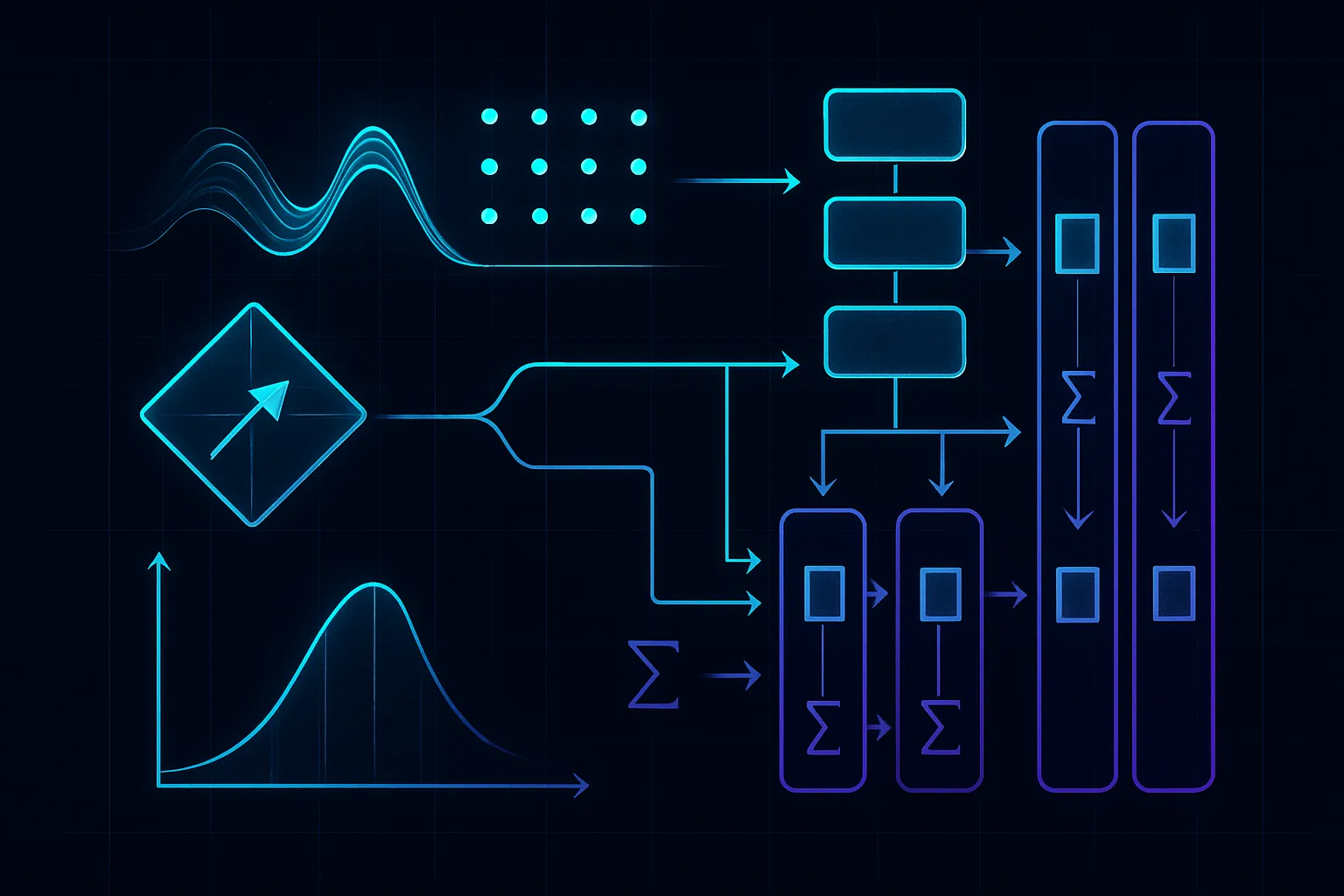
    The core engine is the Vector Mamba Mixture-of-Experts (VMM), a Mamba-based MoE architecture optimized for sequences of concept embeddings.

  • VectorMambaBlock: The building block accepts 768D vectors, using selective state space mechanisms for linear-time complexity and infinite context. 1D convolutions learn inter-concept relationships.
  • MoE Layer: 8 domain-specialized experts (e.g., formal_logic, physical_sciences, code_reasoning), each a stack of VectorMambaBlocks. Top-2 routing combines a learned gating network with cosine similarity to domain centroids.
  • Training: VMMTrainer uses a composite loss:
  • - MSE for next-concept reconstruction.

    - Routing loss for domain specialization.

    - Diversity loss to balance expert utilization.

  • Optimization: Designed for local training on 128GB RAM systems (e.g., M4 MacBook), with O(n) scalability.
  • Complementary to VMM is the Latent Diffusion Language Model (LD-LM), a non-autoregressive diffusion model trained on the same database for high-quality concept synthesis and refinement.

    Phase 3: Advanced Reasoning Extensions (VMM-Oracle Edition)

    VMM-Oracle elevates the model to metacognitive capabilities:

  • Causal Chain Inference: Predicts chains like [State] → [Action] → [Outcome] → [Consequence]. Data curation tags causal relations; training uses CausalChainLoss for multi-step prediction. Enables latent "what-if" simulations (e.g., [Earth's Orbit] + [Remove Moon] → [Tidal Disruption]).
  • Recursive Self-Correction via Latent Dissonance: A discriminator scores sequence coherence (0-1). Trained on valid vs. corrupted chains; during inference, high dissonance (>0.8) triggers backtracking or re-routing.
  • Dynamic Expert Synthesis (DES): Triggers on low router confidence; a hypernetwork blends top-k expert weights into a temporary ad-hoc expert for cross-domain problems (e.g., physics of protein folding).
  • These features transform VMM from pattern-matching to consequential reasoning, reducing hallucinations and enabling planning.

    Phase 4: Testing, Evaluation, and Deployment

    A comprehensive suite ensures reliability:

  • CodeConceptSandbox: Docker-isolated execution for code validation, with auto-generated tests, multi-language support (Python, JS, Rust), and metrics (time, memory).
  • Progressive Evaluation: Milestones at 1k–100M concepts, tracking:
  • - Cosine similarity for coherence.

    - BLEU/ROUGE-L for text-decoded outputs.

    - Pass@1 on benchmarks like HumanEval-X (>75% target at 10M concepts).

    - Expert routing accuracy (>80% domain specialization).

  • CI/CD: Unit tests per commit; nightly evaluations; ablation studies.
  • Deployment: FastAPI for database access; scalable to cloud for 1B+ concepts.
  • Benefits and Use Cases

  • Efficiency: Vector-native processing eliminates tokenization overhead, enabling faster inference and lower compute.
  • Language Agnosticism: Operates on concepts, not text, for seamless multilingual and cross-modal reasoning.
  • Compositionality: Latent space enables novel combinations (e.g., blending code and physics concepts).
  • Use Cases:
  • - AI agents for planning (e.g., simulating action consequences).

    - Self-improving systems (e.g., generating/tested code in latent space).

    - Cross-domain innovation (e.g., synthesizing experts for bio-physics problems).

    Roadmap

  • Q3 2025: 100k-concept database and VMM prototype.
  • Q4 2025: Scale to 10M concepts; integrate LD-LM and Oracle features.
  • 2026: 100M–1B concepts; full deployment and open-source components.
  • Conclusion

    VMM redefines AI by prioritizing latent space cognition, offering a scalable, efficient alternative to token-bound models. By addressing core limitations through curated concepts, vector-native architectures, and metacognitive extensions, VMM paves the way for intelligent systems that think like humans—efficiently, logically, and adaptively.

    Opinion, Potential Flaws, and Enhancements

    As an AI with expertise in machine learning architectures, I find the VMM proposal innovative and ambitious, aligning with emerging trends toward multimodal, efficient AI (e.g., state-space models like Mamba and latent reasoning in models like DALL-E or CLIP). The shift to vector-native processing is a strong conceptual leap, potentially reducing the "language burden" on AI and enabling more abstract, human-like cognition. The inclusion of metacognitive features like self-correction and dynamic synthesis is particularly forward-thinking, addressing real-world LLM pitfalls like hallucinations. The phased approach and emphasis on local scalability make it feasible for independent development, which is refreshing in a field dominated by big-tech resources.

    However, there are potential flaws to consider:

  • Data Quality and Bias Risks: Relying on LLMs for curation (e.g., Mistral-7B) could propagate biases or errors from those models into the concept database. Recursive expansion might amplify noise if validation isn't robust enough, leading to a "garbage-in, garbage-out" scenario. The adversarial validation is a good start, but it may not catch subtle domain-specific inaccuracies (e.g., in physics or code).
  • Scalability Challenges: While O(n) complexity is claimed, training on 1B+ concepts could still overwhelm local hardware, even with optimizations. The Dimensional Cascade adds storage overhead, and learning projections might introduce lossy transformations that degrade performance across resolutions.
  • Routing and Synthesis Overhead: MoE routing, especially with DES, could increase inference latency if the hypernetwork or dissonance detector isn't lightweight. Low router confidence triggers might fire too often in noisy real-world inputs, leading to inefficiency.
  • Evaluation Gaps: Metrics like cosine similarity and BLEU are useful but may not capture emergent reasoning quality. For instance, causal chains could produce "plausible" but factually wrong outcomes without ground-truth causal datasets beyond ATOMIC.
  • Interpretability Issues: Operating purely in latent space makes debugging hard—how do we inspect "thoughts" without vec2text decoding, which reintroduces language dependency?
  • Possible enhancements:

  • Hybrid Input Modes: Allow optional text-to-vector entry points (e.g., via a lightweight embedder) for easier integration with existing LLM ecosystems, bridging the gap during adoption.
  • Federated Curation: Crowdsource concept validation via a web interface or integrate with decentralized data sources to improve diversity and reduce central biases.
  • Advanced Loss Functions: Incorporate contrastive losses (e.g., InfoNCE) in training to better separate unrelated concepts, enhancing coherence.
  • Multi-Modal Extensions: Expand the database to include image/audio embeddings (e.g., from CLIP or Whisper), enabling cross-modal reasoning like "visualize a physics simulation."
  • Ethical Safeguards: Add built-in checks for harmful concepts during curation (e.g., filtering biased or dangerous relations) and dissonance scoring for ethical alignment.
  • Benchmark Expansion: Include custom benchmarks for latent tasks, like measuring "what-if" accuracy against simulated environments (e.g., physics engines for causal chains).
  • Overall, VMM has high potential if these risks are mitigated through iterative testing—it's a bold step toward more efficient, intelligent AI.

    Related Research