> Interactive Explorable Editions Available:
> - ⚡ Launch Main Interactive Paper & DSO Simulator
> - Interactive Visual Suite:
> - Chart 1: Master Dual-Curve & Knowingness Quad
> - Chart 2: 2D Phase-Space & Epistemic Error Explorer
> - Chart 3: Asymmetric Bayesian Kalman Estimator
> - Chart 4: Real-World 40-Trial Domain Scenarios
> - Chart 5: Coupled Skill Acquisition & Trait Dynamics
Abstract
Metacognitive miscalibration—commonly referred to as the Dunning-Kruger effect—is frequently caricatured in popular literature as a single static curve featuring an early peak of inflated confidence followed by a sharp valley of despair. However, empirical percentile data and operational skill-acquisition trajectories reveal a dual-curve topology in which Perceived Ability ($P$) and Actual Ability ($A$) evolve monotonically at different rates, intersecting only at a specific mid-high competence threshold. In this paper, we unify the Dunning-Kruger dual-curve framework with the four-stage Knowingness Quad taxonomy (Novice, Competent, Proficient, Expert) by modeling skill acquisition as a two-bit Gray-Code Epistemic State Machine across Conscious ($C_k \in \{0,1\}$) and Sub-Conscious ($S_k \in \{0,1\}$) processing: $[0,0] \to [1,0] \to [1,1] \to [0,1]$. We prove structurally why the calibration crossover ($P = A$) occurs exclusively within the Proficient ($[1,1]$) regime, and demonstrate that the transition to Expert ($[0,1]$)—where execution offloads from conscious effort to subconscious automation ($C_k: 1 \to 0$)—induces a negative effort-heuristic bias that causes top-quartile performers to systematically underscore their relative percentile ($P < A$).
Furthermore, we extend this population baseline into a coupled stochastic dynamical system modulated by Cybernetic Big-Five trait gains. By treating Conscientiousness and Talent ($C \cdot T$) as the horizontal state velocity ($\dot{A}$) and Extraversion ($\alpha_E$) and Neuroticism ($\alpha_N$) as asymmetric reward and threat Kalman filter gains on perceived competence ($\dot{P}$), we partition the competence phase space into four behavioral phenotypes (Arrogant, Insecure, Humble, Confident). Crucially, this coupled formulation provides a formal mathematical derivation for two pervasive behavioral phenomena: (1) Exposure Volume ($V$) as a Bayesian Damping Force, proving why real-world trial volume is the only mechanism capable of collapsing both low-skill arrogance and high-skill insecurity onto the $P = A$ reality diagonal; and (2) The Perfectionist's Trap ($C \times \alpha_N$ Coupling), explaining why elite practitioners who leverage high neurotic error-detection ($\alpha_N$) and high conscientiousness ($C$) to accelerate their objective mastery into the 95th+ percentile simultaneously trap their internal self-perception in chronic self-doubt unless task-error auditing is decoupled from identity evaluation.
1. Introduction: Beyond the "Mount Stupid" Caricature
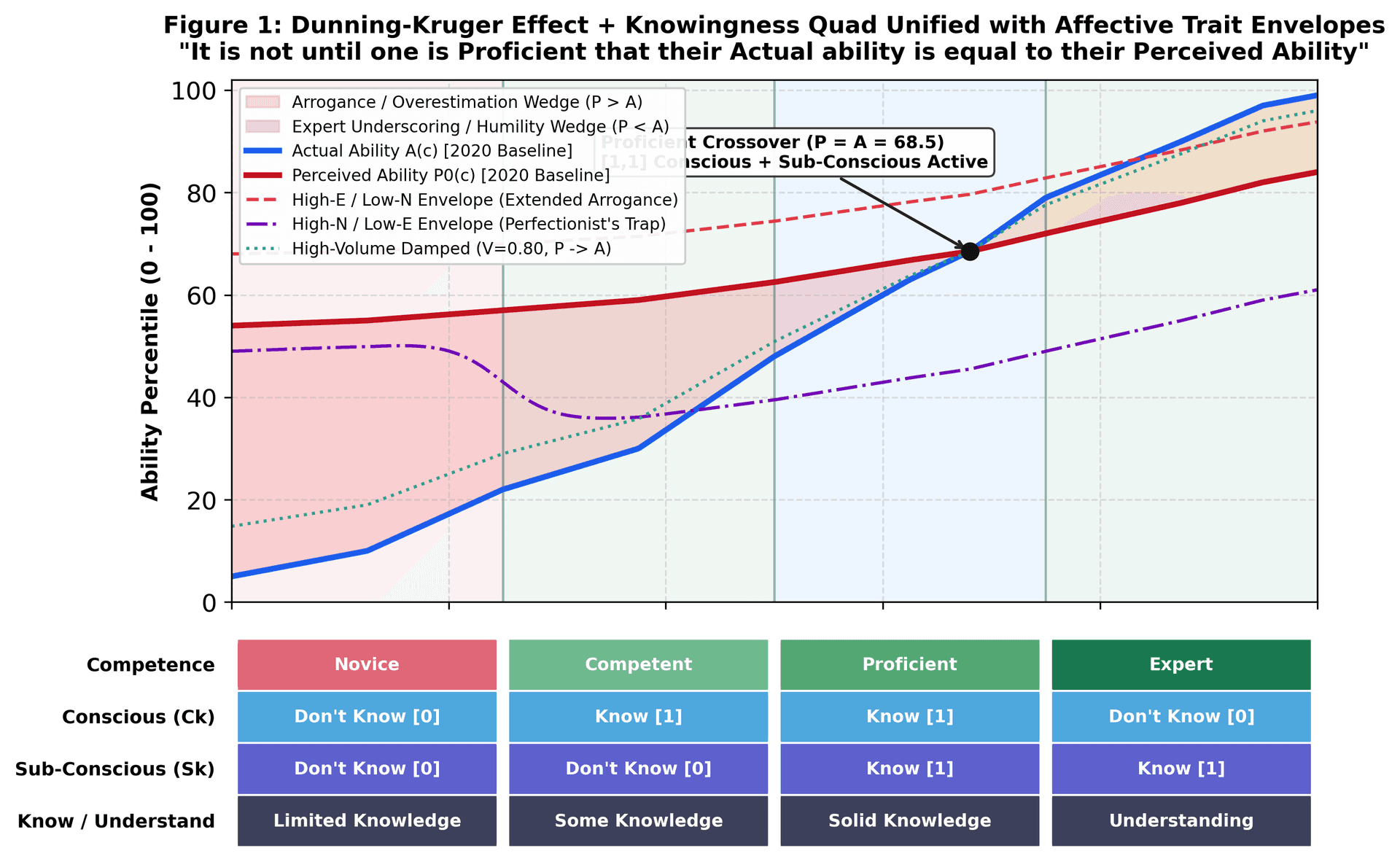
When Perceived Ability $P(c)$ and Actual Ability $A(c)$ are plotted simultaneously against objective domain competence $c \in [0, 100]$, both curves increase monotonically. As established in the March 2020 Dunning-Kruger Effect + Knowingness Quad formulation (Carter, 2020), the core phenomenon is a differential slope and phase-lag problem between two coupled trajectories:
> "It is not until one is Proficient that their Actual ability is equal to their Perceived Ability." (Carter, 2020)
::: {.content-visible when-format="pdf"}
!The Unified Dunning-Kruger + Knowingness Quad Master Diagram showing the 2020 baseline curves, the Proficient Crossover at $c^ \approx 68$, and the Big-Five trait envelopes.{#fig-master width=100%}
:::
::: {.content-visible when-format="html"}
!The Unified Dunning-Kruger + Knowingness Quad Master Diagram (Static Snapshot; see interactive canvas in index.html).{#fig-master-html width=100%}
:::
2. The Knowingness Quad as a Gray-Code Epistemic State Machine
Human skill execution and self-evaluation rely on two distinct computational buses:
The Conscious Bus ($C_k \in \{0, 1\}$): Explicit, declarative, working-memory-intensive rule processing and active error monitoring. The Sub-Conscious Bus ($S_k \in \{0, 1\}$): Implicit, procedural, basal-ganglia and cerebellar schema automation.Mapping Don't Know to $0$ and Know to $1$, human competence progression across the four regimes (Novice, Competent, Proficient, Expert) follows a strict 2-bit reflected binary Gray Code:
$$\mathbf{k}(c) = \begin{bmatrix} C_k(c) \\ S_k(c) \end{bmatrix} : \quad \begin{bmatrix} 0 \\ 0 \end{bmatrix}_{\text{Novice}} \longrightarrow \begin{bmatrix} 1 \\ 0 \end{bmatrix}_{\text{Competent}} \longrightarrow \begin{bmatrix} 1 \\ 1 \end{bmatrix}_{\text{Proficient}} \longrightarrow \begin{bmatrix} 0 \\ 1 \end{bmatrix}_{\text{Expert}}$$
3. Mathematical Derivation of the Proficient Crossover and Expert Underscoring
Define the Epistemic Calibration Error as the signed residual $\Delta_0(c) \equiv P_0(c) - A(c)$.
Because $\Delta_0(50) = 63 - 52 = +11 > 0$ and $\Delta_0(75) = 72 - 79 = -7 < 0$, by the Intermediate Value Theorem and strict monotonicity of $\Delta_0(c)$, there exists a unique interior fixed point $c^ \in (50, 75)$ where:
$$\Delta_0(c^) = P_0(c^) - A(c^) = 0 \implies c^ \approx 68.0, \quad A(c^) = P_0(c^) \approx 68.5$$
At the transition from Proficient ($[1,1]$) to Expert ($[0,1]$), $\Delta C_k = -1$. Because internal self-assessment relies partially on perceived prefrontal metabolic effort ($\propto C_k$), the $C_k: 1 \to 0$ transition makes complex tasks feel trivially easy to the expert, leading to systematic underestimation of one's relative percentile ($\Delta_0 = -15$ at $c = 95$).
!Epistemic Calibration Error Residual and Gray-Code State Switching.{#fig-residual width=100%}
4. Affective Gain Modulation & The Asymmetric Diode Rectifier Model
4.1 The Four Behavioral Phenotypes in $(A, P)$ Space
Projecting Actual Ability ($A$) and Perceived Ability ($P$) onto a 2D orthogonal phase plane partitions human behavior into four distinct operational zones separated by $A_{\text{crit}} = 50$ and a calibration boundary $P_{\text{cal}}(A)$:
!2D Phase-Space Projection Across the Four Behavioral Phenotypes.{#fig-phase width=85%}
4.2 The Signal-Processing Analogy (Asymmetric Kalman Filter / Diode Detector)
Think of objective skill $A$ as a carrier signal generating a noisy stream of daily successes ($e(t) > 0$) and failures ($e(t) < 0$) around a true mean:
Extraversion ($\alpha_E$) is the forward gain on the positive half-wave of the prediction-error signal.
Neuroticism ($\alpha_N \cdot C_k$) is the forward gain on the negative half-wave of the signal, gated by the Conscious bit $C_k$. Self-Perception ($P(t)$) is the DC bias (the integrated capacitor voltage $V_C$) across a leaky RC integrator damped by Exposure Volume ($V$):$$v_{\text{rect}}(t) = \alpha_E \cdot \max\big(0, e(t)\big) + \alpha_N \cdot C_k \cdot \min\big(0, e(t)\big)$$
$$\tau_V \frac{dP(t)}{dt} + P(t) = A + (1 - V) \cdot v_{\text{rect}}(t)$$
!Digital Storage Oscilloscope (DSO) Trace of the Asymmetric Diode Rectifier and Self-Perception RC Integrator.{#fig-dso width=100%}
5. Coupled Dynamical Trajectory & Volume Damping ($N = 40$ Trials)
Incorporating the achievement relation $\dot{A} \propto C \cdot \text{Talent}$, high-Conscientiousness learners extract structural skill growth disproportionately from failures ($R_t^- = 1$) via root-cause debugging:
$$A_{t+1} = A_t + \gamma \cdot (C \cdot \text{Talent}) \cdot \left( \frac{100 - A_t}{100} \right) \cdot \left[ 1 + \beta_{\text{debug}} \cdot \alpha_N \cdot \mathbb{I}(R_t^- = 1) \right]$$
!40-Trial Coupled Dynamical Trajectory.{#fig-trials width=100%}