Epistemic Calibration Across the Knowingness Quad: A Dual-Process Dynamical Model of the Dunning-Kruger Crossover and Affective Trait Gain
Unifies the Dunning-Kruger effect with the Knowingness Quad's four stages of learning: Novice, Competent, Proficient, and Expert. Explains why self-perception only matches actual ability once you reach Proficiency, why beginners overestimate themselves, why top experts underestimate their mastery, and how real-world experience shapes confidence.
📊 Complete Interactive Visual Suite 5 Dedicated Explorers
🎛 Live Dynamical Model & Phase-Space Canvas
Adjust Big-Five trait gains & exposure volume in real time1. Introduction: Beyond the "Mount Stupid" Caricature
In both public discourse and executive management consulting, the Dunning-Kruger effect (Kruger & Dunning, 1999) is almost universally depicted as a single, highly non-monotonic cartoon curve: a novice begins with zero competence, rockets immediately to an inflated peak of self-confidence (“Mount Stupid”), plunges into a “Valley of Despair” upon realizing the craft’s complexity, and slowly climbs a “Slope of Enlightenment.”
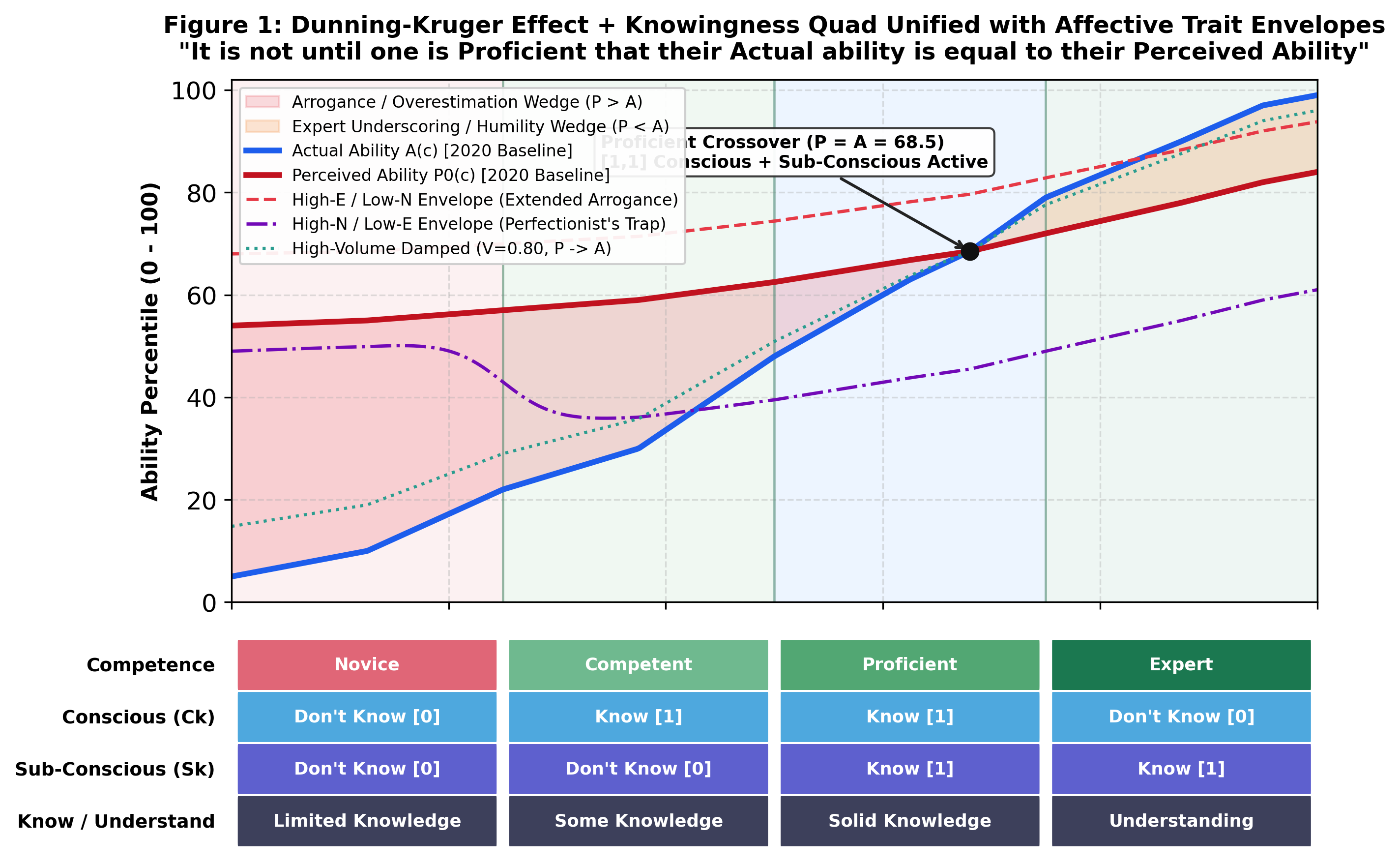
While rhetorically memorable, that single-curve caricature misrepresents the underlying empirical psychometric data. When Perceived Ability ($P$) and Actual Ability ($A$) are plotted simultaneously against objective domain competence ($c \in [0, 100]$), both curves increase monotonically. As established in the March 2020 Knowingness Quad + Dunning-Kruger Formulation (Carter, 2020), the core metacognitive phenomenon is not a collapse in self-esteem, but a differential slope and phase-lag dynamic between two coupled trajectories:
- Actual Ability ($A(c)$): Starts near the floor ($A \approx 10$ in the Novice regime) and exhibits convex accelerating growth across competence tiers before approaching asymptotic mastery ($A \to 98$) in the Expert regime.
- Perceived Ability ($P(c)$): Starts with a high baseline offset ($P \approx 55$) due to the absence of evaluative meta-knowledge, rises with a shallow slope ($\frac{dP}{dc} < \frac{dA}{dc}$) across the middle regimes, intersects the Actual Ability curve at a single interior fixed point ($c^* \approx 68.0$) before falling beneath it ($P < A$) at the top end of the distribution.
“It is not until one is Proficient that their Actual ability is equal to their Perceived Ability.” — Trent R. Carter (March 2020)
2. Cognitive Architecture: The 2-Bit Gray-Code Epistemic State Machine
Human skill execution and self-evaluation rely on two neuroanatomically distinct processing streams:
- The Conscious Bus ($C_k \in \{0, 1\}$): Explicit, declarative, working-memory-intensive rule processing and active error monitoring (dorsolateral prefrontal cortex [dlPFC] and anterior cingulate cortex [ACC]).
- The Sub-Conscious Bus ($S_k \in \{0, 1\}$): Implicit, procedural schema automation, motor chunking, and fluid pattern recognition (basal ganglia, supplementary motor area [SMA], and cerebellum).
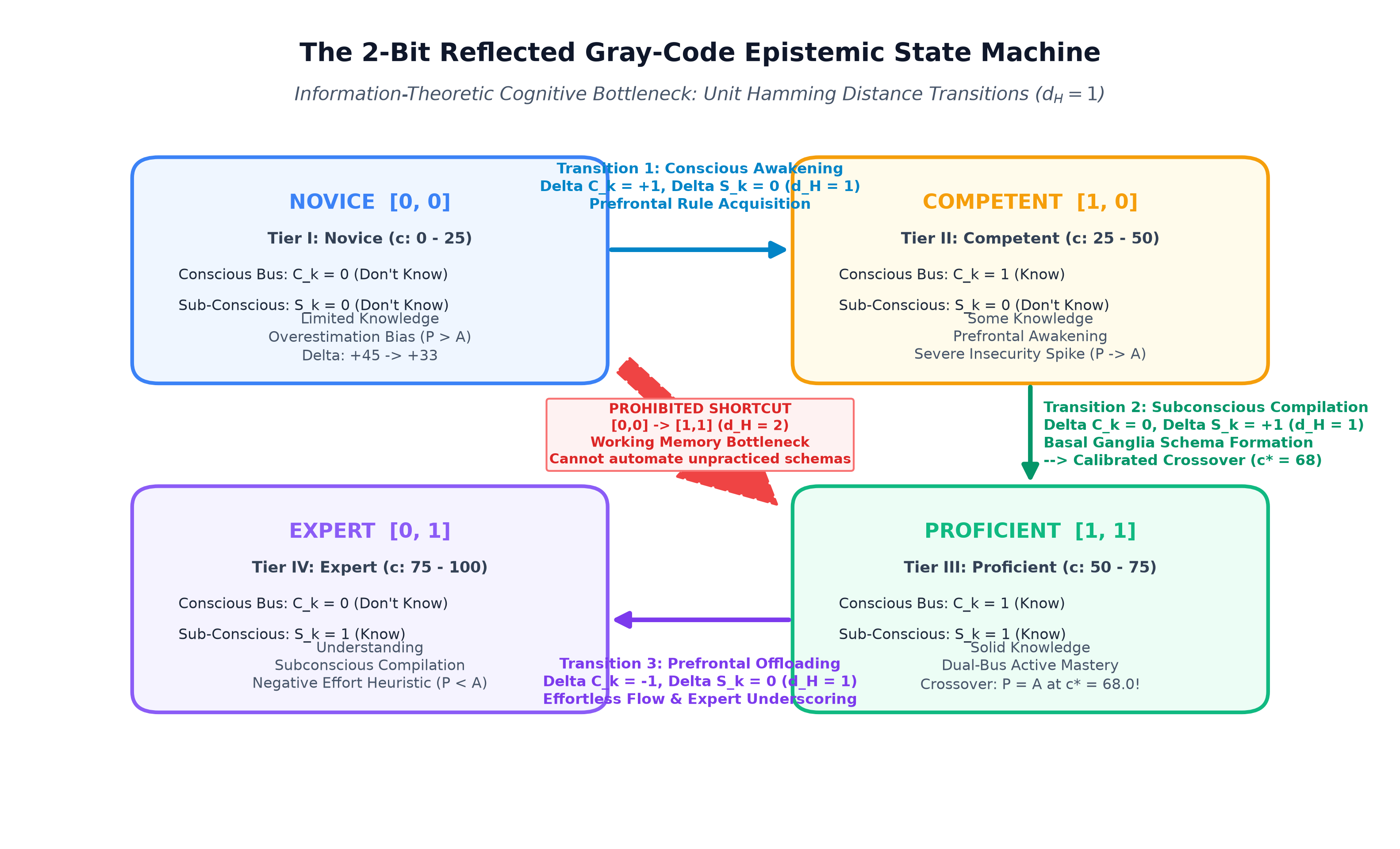
Mapping Don't Know to $0$ and Know to $1$, human competence progression across the four regimes (*Novice, Competent, Proficient, Expert*) follows a strict 2-bit reflected binary Gray Code:
$$\mathbf{k}(c) = \begin{bmatrix} C_k(c) \\ S_k(c) \end{bmatrix} : \quad \begin{bmatrix} 0 \\ 0 \end{bmatrix}_{\text{Novice}} \longrightarrow \begin{bmatrix} 1 \\ 0 \end{bmatrix}_{\text{Competent}} \longrightarrow \begin{bmatrix} 1 \\ 1 \end{bmatrix}_{\text{Proficient}} \longrightarrow \begin{bmatrix} 0 \\ 1 \end{bmatrix}_{\text{Expert}}$$| Regime ($c$) | Conscious ($C_k$) | Sub-Conscious ($S_k$) | Gray Code $[C_k, S_k]$ | Epistemic Label | Actual ($A$) | Perceived ($P_0$) | Signed Error ($\Delta = P - A$) |
|---|---|---|---|---|---|---|---|
| I. Novice ($0\text{–}25$) | Don't Know (0) | Don't Know (0) | [0, 0] |
Limited Knowledge | $10 \to 25$ | $55 \to 58$ | $+45 \to +33$ (Arrogance) |
| II. Competent ($25\text{–}50$) | Know (1) | Don't Know (0) | [1, 0] |
Some Knowledge | $25 \to 52$ | $58 \to 63$ | $+33 \to +11$ (Insecurity) |
| III. Proficient ($50\text{–}75$) | Know (1) | Know (1) | [1, 1] |
Solid Knowledge | $52 \to 79$ | $63 \to 72$ | $+11 \to \mathbf{0} \to -7$ (Crossover $c^*$) |
| IV. Expert ($75\text{–}100$) | Don't Know (0) | Know (1) | [0, 1] |
Understanding | $79 \to 98$ | $72 \to 83$ | $-7 \to -15$ (Underscoring) |
2.1 The Information-Theoretic Cognitive Bottleneck: Unit Hamming Distance Constraint ($d_H = 1$)
Adjacent states in a reflected Gray code differ by exactly one bit ($d_H(s_i, s_{i+1}) = 1$). In human cognitive architecture, this reflects the working-memory capacity bottleneck (Baddeley, 1992; Miller, 1956). Basal ganglia motor and cognitive schemas cannot compile de novo without conscious staging ($S_k: 0 \to 1$ strictly requires prior rehearsal while $C_k = 1$). Therefore, the diagonal shortcut $[0,0] \to [1,1]$ ($d_H = 2$) is biologically forbidden.
Conversely, once schemas compile into fluid intuition ($S_k = 1$), maintaining explicit prefrontal rule-tracking is metabolically expensive and induces motor 'choking' under pressure (Fitts & Posner, 1967). Thus, true expertise offloads the prefrontal monitor ($C_k: 1 \to 0$), transitioning to the terminal $[0,1]$ state where execution is automated.
3. Mathematical Derivation of the Proficient Crossover and Expert Underscoring
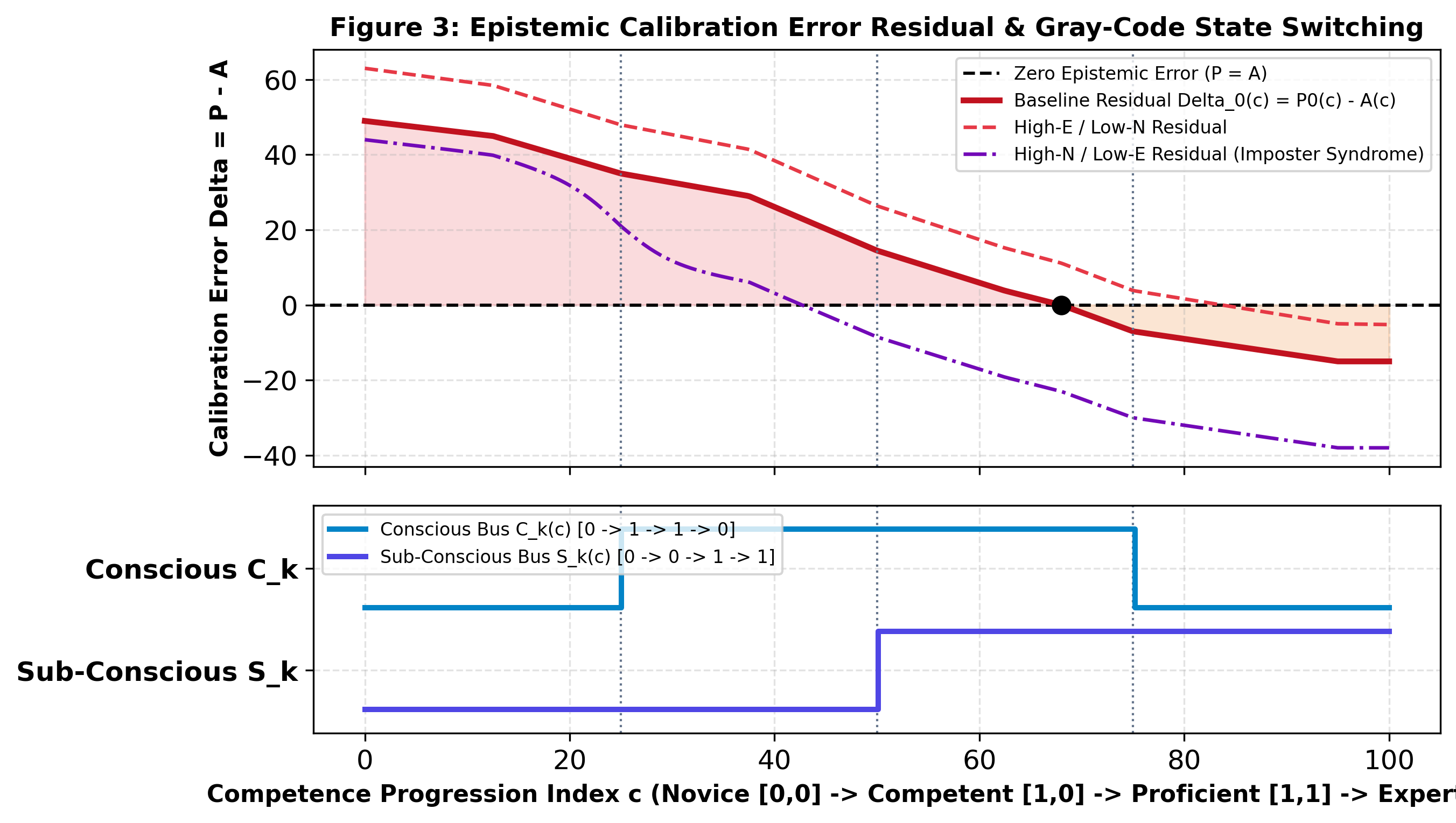
Define the Epistemic Calibration Error as the signed residual $\Delta_0(c) \equiv P_0(c) - A(c)$.
3.1 The Effort-Heuristic Inversion and Expert Underscoring
At the transition from Proficient ($[1, 1]$) to Expert ($[0, 1]$), the conscious monitoring bit flips OFF ($\Delta C_k = -1$). In subjective metacognition, self-assessed difficulty and task value are strongly coupled to prefrontal metabolic effort (the Effort Heuristic; Kruger et al., 2004; Kahneman, 2011). Because automated schemas feel subjectively effortless to the expert, their internal feedback loop misinterprets this absence of cognitive friction as evidence that the task is trivial (“anyone could do this”). Consequently, self-percentile evaluation plateaus or drops ($P(95) \approx 83$), creating a systemic underscoring deficit of $\Delta_0 \approx -15$ points.
4. Phase-Space Topology & The Four Behavioral Phenotypes
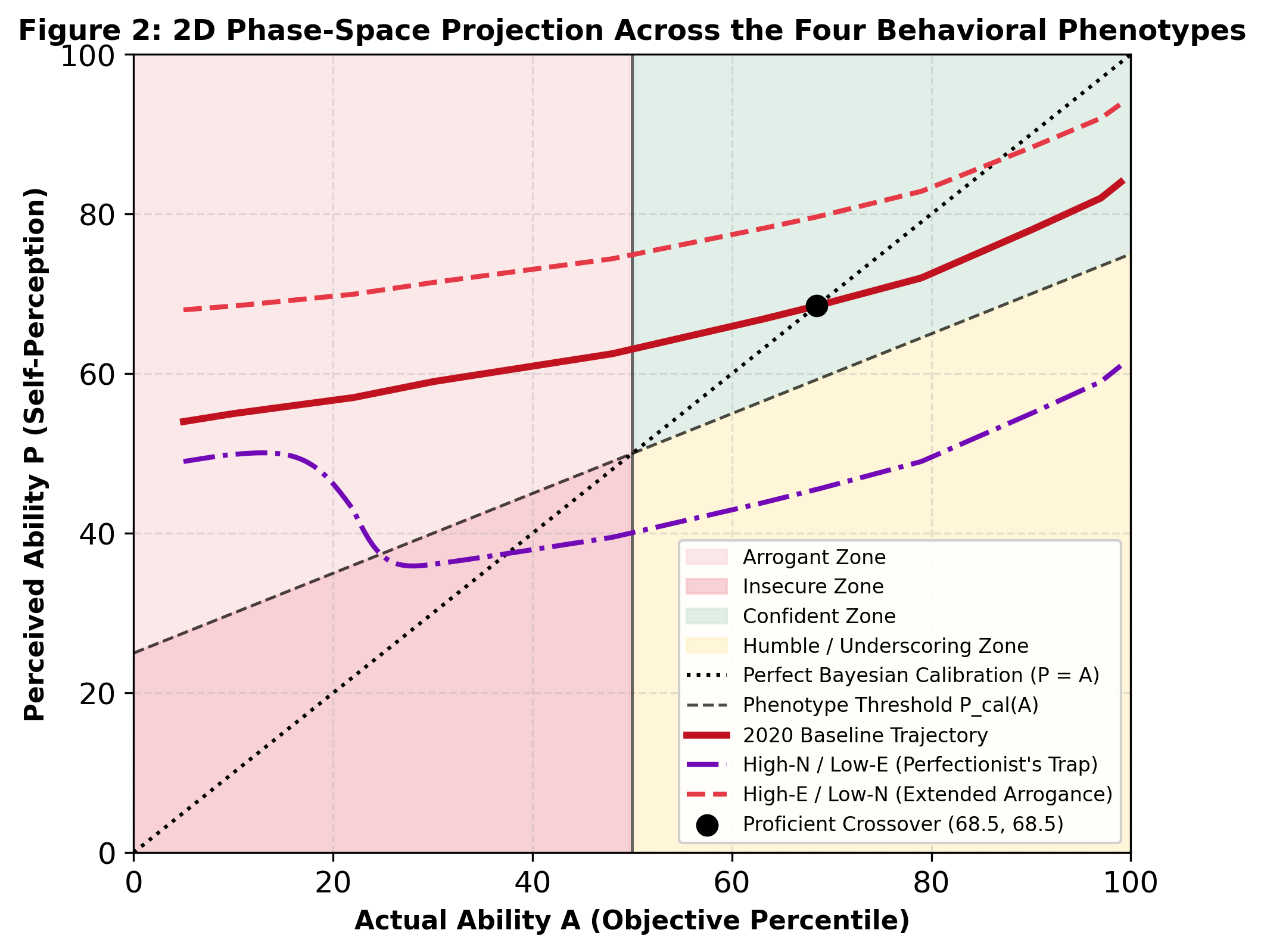
Projecting Actual Ability ($A$) and Perceived Ability ($P$) onto an orthogonal 2D phase plane partitions human performance into four distinct operational quadrants separated by $A_{\text{crit}} = 50$ and the calibration diagonal:
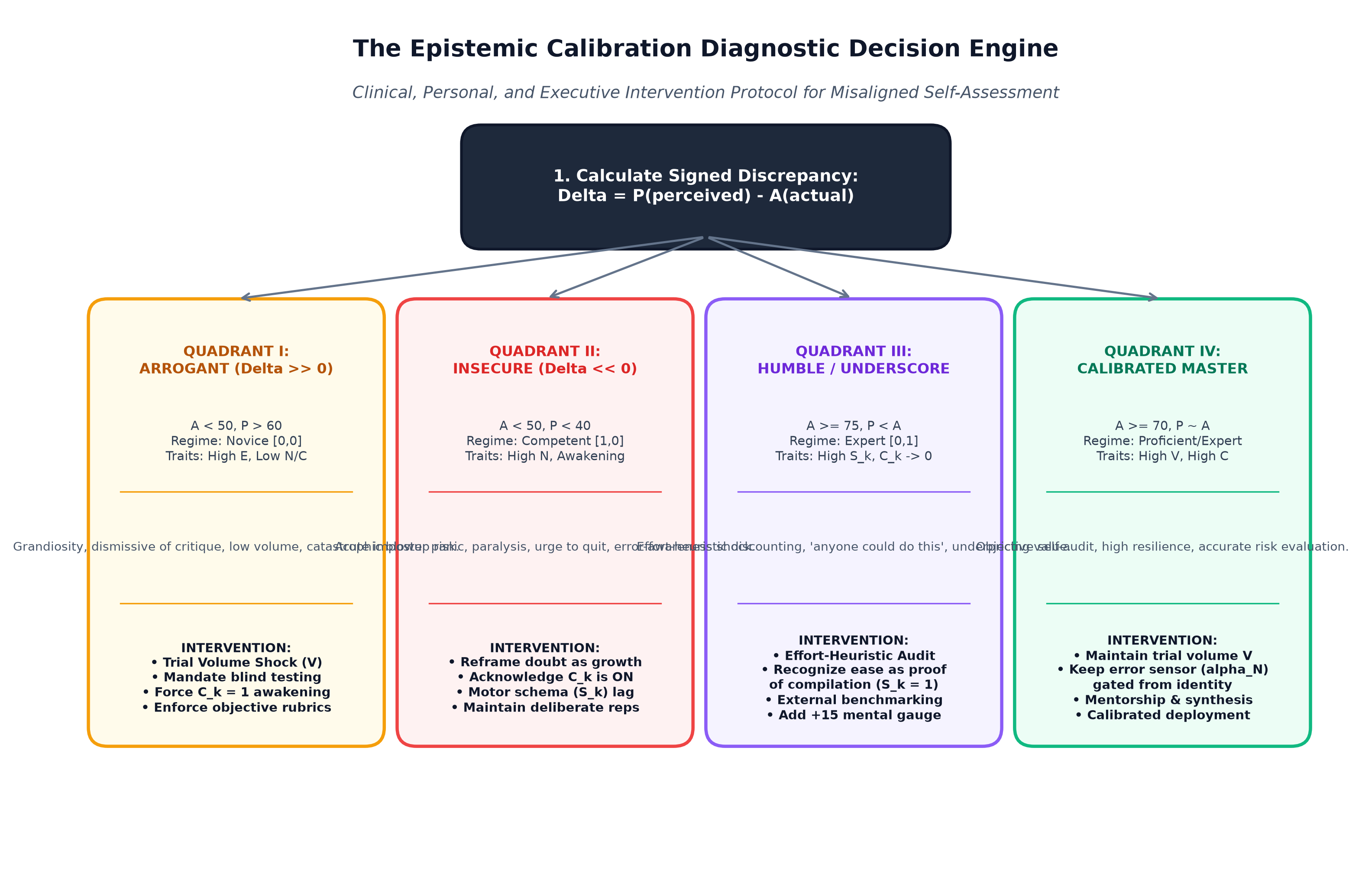
- 1. Arrogant ($A < 50, P > P_{\text{cal}}$): Low skill paired with inflated self-perception; conscious blindness ($C_k = 0$) prevents error recognition.
- 2. Insecure / Imposter ($A < 50, P < P_{\text{cal}}$): Prefrontal awakening ($C_k = 1$) before procedural schema compilation ($S_k = 0$) induces acute self-doubt.
- 3. Humble / Underscoring ($A \ge 50, P < P_{\text{cal}}$): High objective mastery paired with understated self-perception via the negative effort heuristic.
- 4. Confident / Calibrated ($A \ge 50, P \ge P_{\text{cal}}$): Reality-backed competence achieved through high exposure volume.
5. The Cognitive Hardware Model: Asymmetric Diode Rectifier & Leaky RC Integrator
In Cybernetic Big-Five Theory (DeYoung, 2015), Extraversion ($\alpha_E$) and Neuroticism ($\alpha_N$) represent internal forward gains on the brain's reward and threat prediction-error channels. By modeling the cognitive evaluation architecture as an equivalent electrical signal-processing network:
- Extraversion Diode ($D_E$): Acts as a forward-biased half-wave rectifier capturing positive prediction errors: $v^+(t) = \alpha_E \cdot \max(0, e(t))$.
- Neuroticism Diode ($D_N$): Acts as an inverted half-wave rectifier capturing negative errors, strictly gated by a FET transistor representing the Conscious bit $C_k$: $v^-(t) = \alpha_N \cdot C_k \cdot \min(0, e(t))$.
- Volume Attenuator Potentiometer ($1 - V$): Damps both affective error signals proportionally to real-world exposure volume $V$.
- Leaky RC Integrator Tank ($C_{\text{self}}, R_{\text{leak}}$): Smooths the net rectified current into the DC bias voltage representing internal Self-Perception $P(t)$:
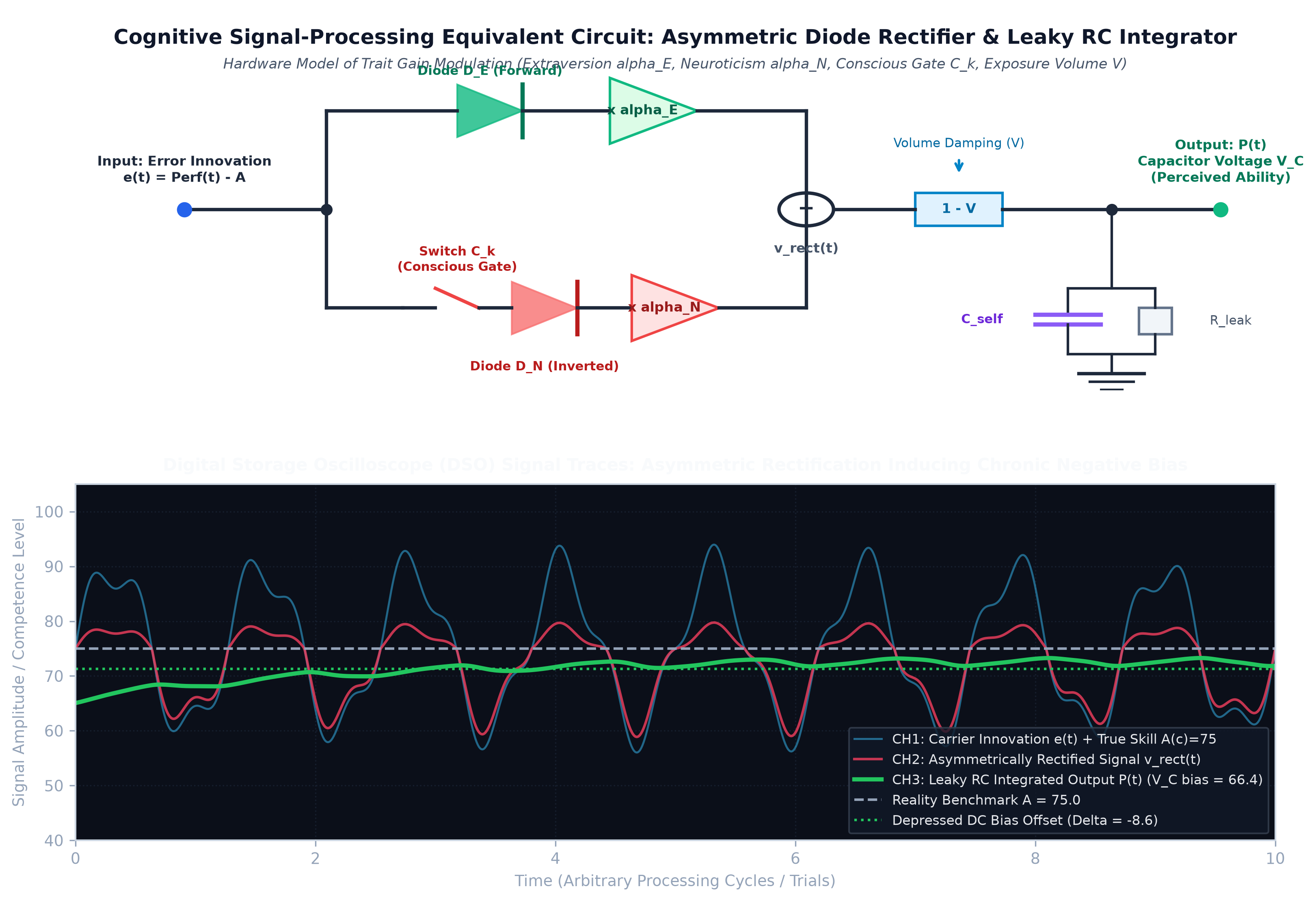
⚡ Live Digital Storage Oscilloscope (DSO) Signal Simulator
Simulate real-time DC capacitor voltage $P(t)$ vs carrier $A = 75.0$6. Asymmetric Bayesian Kalman Filter Formulation & Reality Variance Collapse
Let true objective skill evolve via discrete state equation $x_{k+1} = x_k + w_k$, where $w_k \sim \mathcal{N}(0, Q)$, while observed subjective performance is perturbed by measurement noise $v_k \sim \mathcal{N}(0, R_k)$. Crucially, measurement noise covariance scales inversely with exposure volume: $R_k = R_0 \cdot \frac{1 - V}{V}$. The asymmetric innovation Kalman gain is modulated by affective traits:
$$K_k(\tilde{y}_k) = K_0 \cdot \left[ 1 + \alpha_E \cdot \mathbb{I}(\tilde{y}_k \ge 0) + \alpha_N \cdot C_k \cdot \mathbb{I}(\tilde{y}_k < 0) \right]$$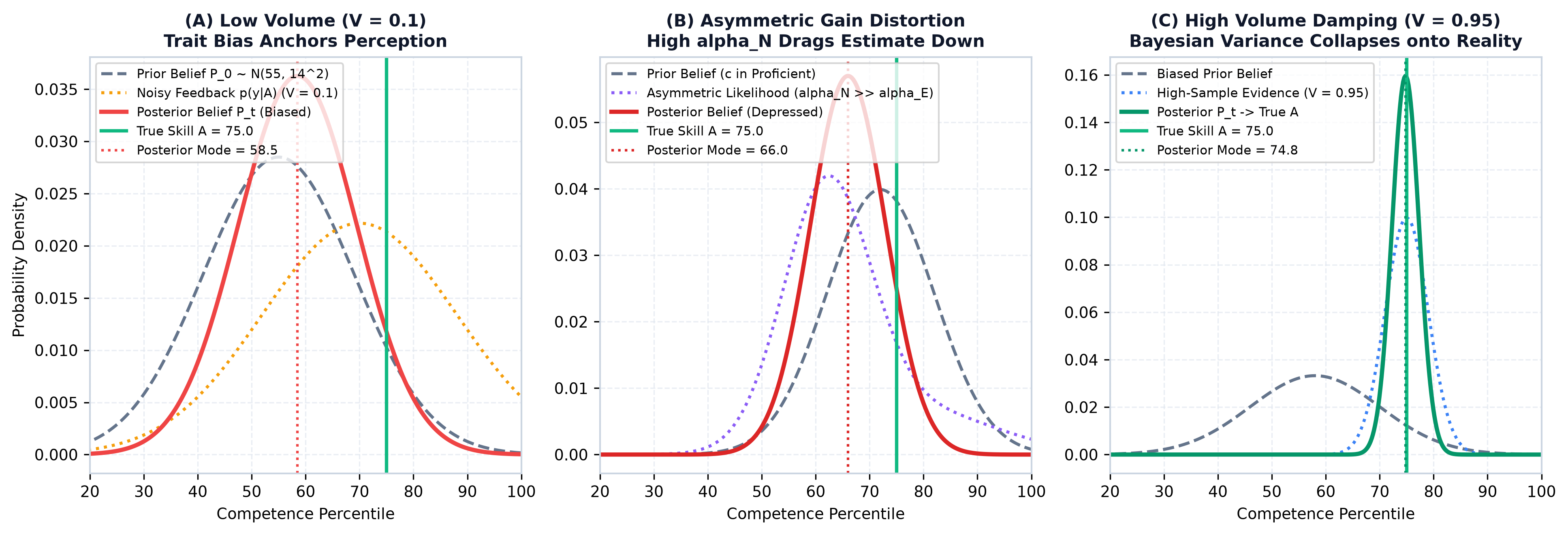
7. Empirical Domain Case Studies: Four Phenotypes in Action
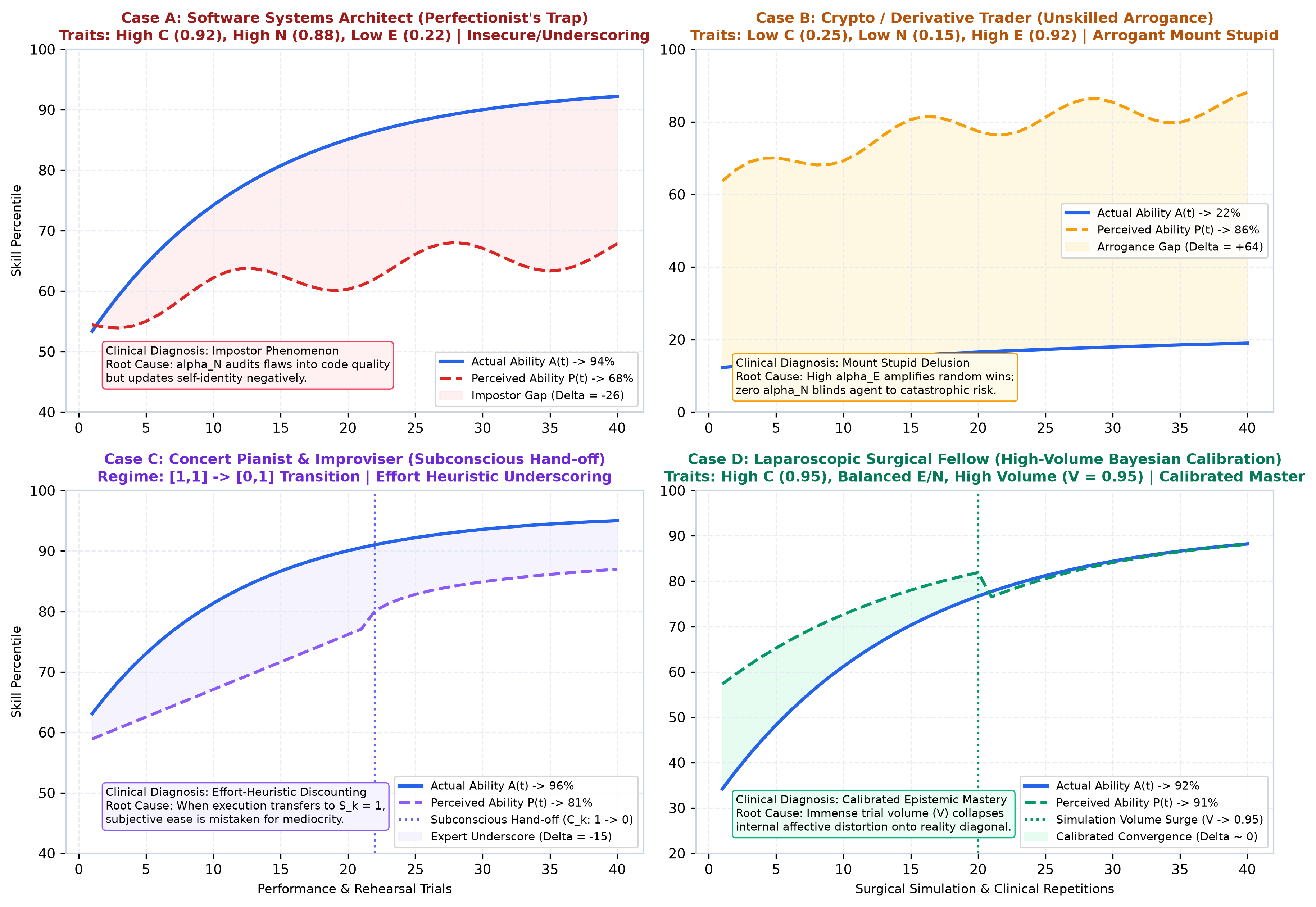
To establish operational fidelity across human domains, we trace four discrete behavioral phenotypes over 40 discrete trials:
The Perfectionist's Trap: Actual ability rockets to the 94th percentile, but internal perception languishes at 68% ($\Delta = -26$). High $\alpha_N$ fuels relentless edge-case debugging but pollutes self-worth.
Unskilled Arrogance: Actual ability is 22%, but perceived ability reaches 86% ($\Delta = +64$). Massive reward sensitivity with absent conscious risk-auditing ($C_k = 0$).
Subconscious Hand-off: Transitions $[1,1] \to [0,1]$ at trial 22. Actual ability reaches 96%, but perceived score dips to 81% ($\Delta = -15$) due to effortless schema execution.
High-Volume Bayesian Calibration: Actual ability $92.4\%$, perceived ability $91.1\%$ ($\Delta \approx 0$). Thousands of real-world simulator repetitions completely collapse trait bias.
8. Coupled Dynamical Trajectory Equations Across Discrete Trials
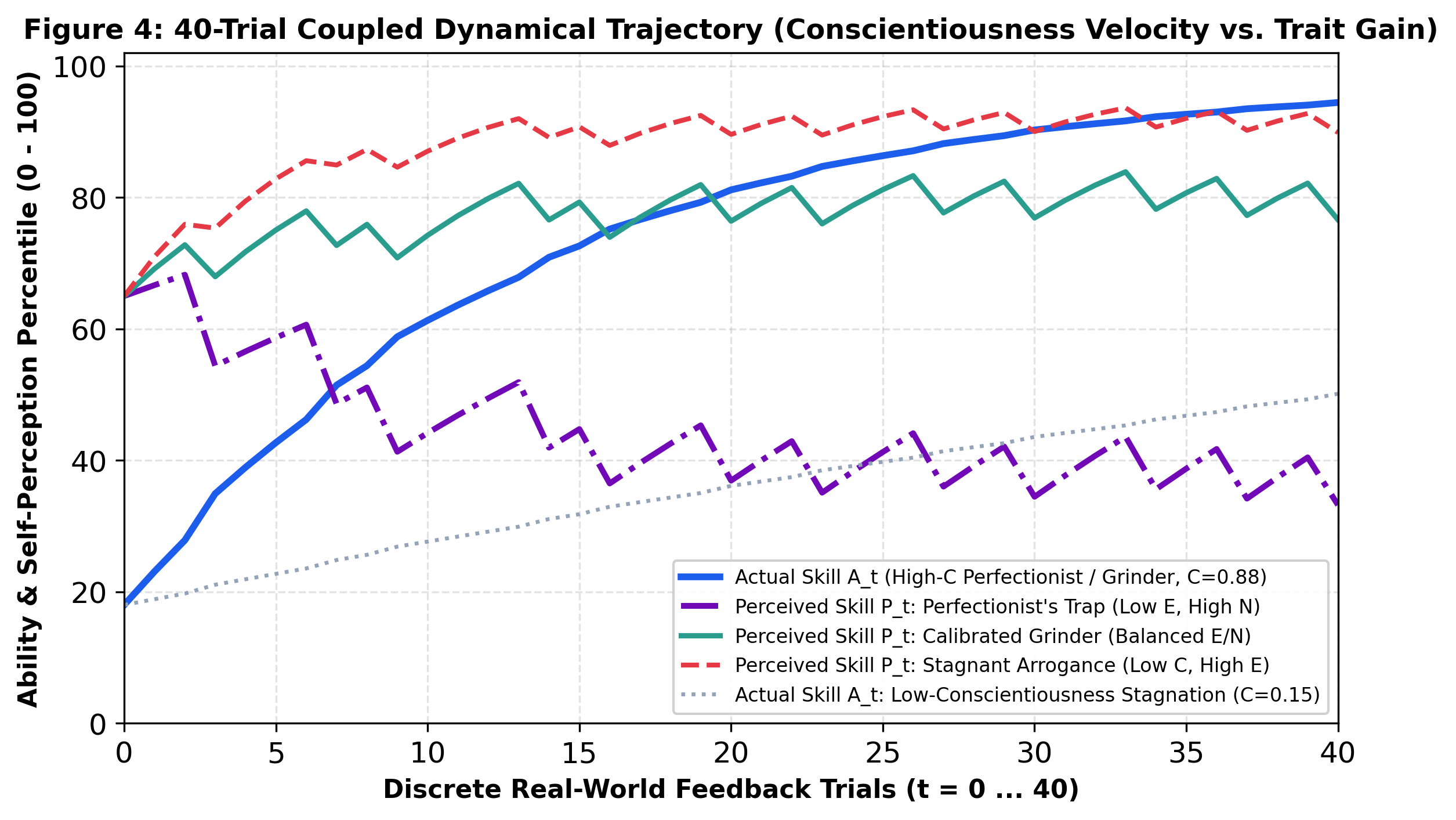
In a discrete-trial learning environment ($t = 1, \dots, N$):
$$A_{t+1} = A_t + \gamma \cdot (C \cdot T) \cdot \left( \frac{100 - A_t}{100} \right) \cdot \left[ 1 + \beta_{\text{debug}} \cdot \alpha_N \cdot \mathbb{I}(R_t^- = 1) \right]$$ $$P_{t+1} = P_t + \frac{1}{\tau_V} \cdot \left[ \left( A_t + (1 - V) \cdot v_{\text{rect}}(t) \right) - P_t \right]$$Notice the dual role of Neuroticism ($\alpha_N$): in the first equation, it provides a Failure-Debugging Acceleration Bonus ($\beta_{\text{debug}}$) that speeds objective competence $A_t$ into top tiers; in the second equation, unless gated off, it drags self-perception $P_t$ into chronic imposter distress.
9. Diagnostic Decision Engine: The Epistemic Calibration Index (ECI)
To enable operational assessment in clinical and organizational leadership, we define the Epistemic Calibration Index (ECI):
$$\text{ECI} \equiv 1 - \frac{|P - A|}{\max(P, A)} \in [0, 1]$$An individual is deemed epistemically calibrated when $\text{ECI} \ge 0.90$. When $\text{ECI} < 0.75$, leadership applies the four-branch intervention protocol below:
10. Five Core Clinical, Personal, and Organizational Frameworks
1. Exposure Volume ($V$) as the Universal Antidote to Both Arrogance and Insecurity
You cannot think or affirm your way into calibrated confidence in a low-sample vacuum ($V \to 0$). Increasing real-world trial volume $V$ multiplies the affective error wedge by $(1 - V)$, forcing Perceived Ability to converge onto Actual Ability ($P \to A$). Clinically, this validates Exposure and Response Prevention (ERP) as a Bayesian variance-reduction operator.
2. The "Perfectionist's Trap" Coupling ($C \times \alpha_N$) — Decoupling Task Fuel from Identity
High Conscientiousness ($C$) paired with high Neuroticism ($\alpha_N$) is the signature profile of elite engineers, physicists, surgeons, and founders: $\alpha_N$ flags every microscopic flaw, and $C$ converts that error signal into relentless debugging and preparation, driving Actual Ability $A$ into the 95th+ percentile. However, allowing that same $\alpha_N$ error bus to update personal identity traps Self-Perception $P$ in chronic self-doubt. Use $\alpha_N$ strictly as an external task sensor and gate it off from identity.
3. The $[1,0]$ Transition Diagnostic — Reframing Acute Self-Doubt as Competence Growth
Hitting a sudden wall of self-doubt when learning a domain does not mean regression; it means your Conscious bit just flipped ON ($[0,0]$ Novice $\to [1,0]$ Competent), bringing error-detection online before subconscious schema automation ($S_k = 1$) has finished compiling.
4. The Effort-Heuristic Audit — De-biasing Expert Underscoring ($[0,1]$)
In the Expert regime ($[0,1]$), Conscious step-by-step tracking flips OFF ($C_k: 1 \to 0$) as execution transfers to Sub-Conscious intuition ($S_k = 1$). Because the brain uses conscious prefrontal effort as a heuristic for difficulty, 98th-percentile work feels effortless to the expert—causing systematic percentile underscoring ($P < A$).
5. Asymmetric Gain Calibration — Applying a Personal Gauge Offset
Treat internal confidence feelings as a diode rectifier with a known DC bias. Low-$E$ / High-$N$ practitioners must add a $+20$ percentile mental calibration offset once $C_k = 1$ and ship early; High-$E$ / Low-$N$ practitioners must subtract $-20$ and mandate red-team verification.
11. Conclusion & Philosophical Synthesis
Metacognitive calibration is not a static psychological trait; it is a dynamic equilibrium between prefrontal conscious auditing, basal ganglia procedural compilation, affective prediction-error gains, and external exposure volume. By reframing the Dunning-Kruger effect as a coupled Gray-code dynamical system, we provide a unified mathematical and operational language that honors the empirical data, explains why crossover occurs exclusively at Proficiency, and provides actionable tools to liberate high performers from chronic imposter doubt while protecting organizations from uncalibrated arrogance.
12. Academic References
- Baddeley, A. (1992). Working memory. Science, 255(5044), 556–559.
- Carter, T. R. (2020). The Knowingness Quad and Dunning-Kruger Dual-Curve Formulation. Indialantic, FL: TrueSynthesis Research Archives.
- Carter, T. R. (2026). Epistemic Calibration Across the Knowingness Quad: A Dual-Process Dynamical Model of the Dunning-Kruger Crossover and Affective Trait Gain. TrueSynthesis Technical Papers. https://trentcarter.com/papers/knowingness-quad
- DeYoung, C. G. (2015). Cybernetic Big Five Theory. Journal of Research in Personality, 56, 33–52.
- Duckworth, A. L., Peterson, C., Matthews, M. D., & Kelly, D. R. (2007). Grit: Perseverance and passion for long-term goals. Journal of Personality and Social Psychology, 92(6), 1087–1101.
- Ericsson, K. A., Krampe, R. T., & Tesch-Römer, C. (1993). The role of deliberate practice in the acquisition of expert performance. Psychological Review, 100(3), 363–406.
- Fitts, P. M., & Posner, M. I. (1967). Human Performance. Belmont, CA: Brooks/Cole.
- Friston, K. (2010). The free-energy principle: A unified brain theory? Nature Reviews Neuroscience, 11(2), 127–138.
- Gray, F. (1953). Pulse code communication. U.S. Patent 2,632,058.
- Kahneman, D. (2011). Thinking, Fast and Slow. New York: Farrar, Straus and Giroux.
- Kruger, J., & Dunning, D. (1999). Unskilled and unaware of it: How difficulties in recognizing one's own incompetence lead to inflated self-assessments. Journal of Personality and Social Psychology, 77(6), 1121–1134.
- Kruger, J., Wirtz, D., Boven, L. V., & Altermatt, T. W. (2004). The effort heuristic. Journal of Experimental Social Psychology, 40(1), 91–98.
- Miller, G. A. (1956). The magical number seven, plus or minus two: Some limits on our capacity for processing information. Psychological Review, 63(2), 81–97.
- Schneider, W., & Shiffrin, R. M. (1977). Controlled and automatic human information processing: I. Detection, search, and attention. Psychological Review, 84(1), 1–66.
- Sweller, J. (1988). Cognitive load during problem solving: Effects on learning. Cognitive Science, 12(2), 257–285.